“I hope to give the viewers an experience, a memory and a sense of the absurd and magic”, Mons Jorgensen
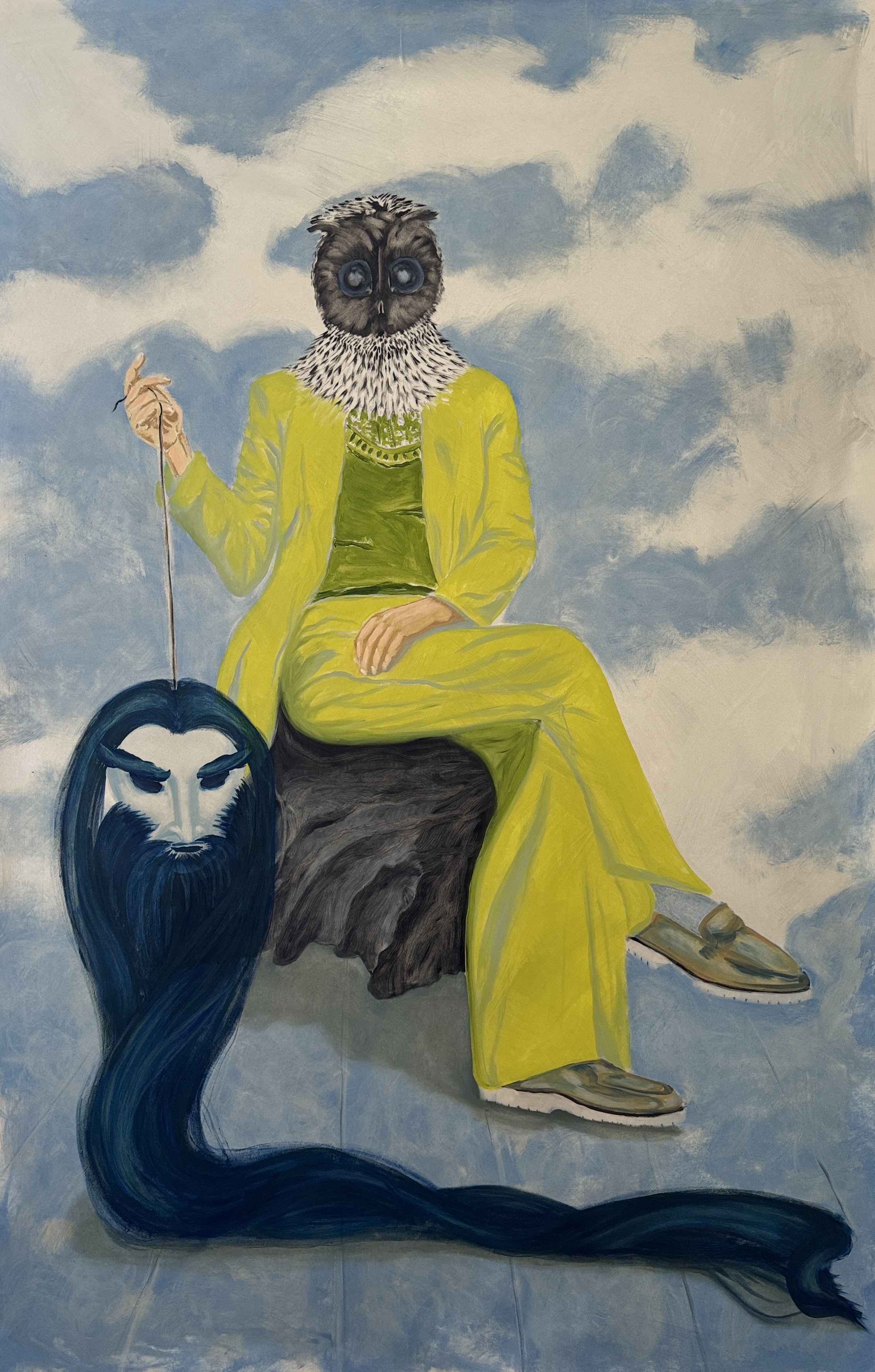
WELCOME to the artistic world of Mons Jorgensen, where myth and fairytale intertwine with psychological truths and the nature of human kind. Jorgensen’s work featured in a solo exhibition in Athens, at Art Athina this year, represented by Spazio b5 from Bologna. Her mystical works, travelled viewers to a timeless place, where elements of the Mediterranean landscape were combined with human figures from ancient Greek drama, dance and mythology. Together with them, the bearded man of Northern folk stories and legends also made his presence felt. It was a union of cultures and mindsets, where symbols such as the owl of Athena spookily flew across the landscape, or looked you straight in the eye.
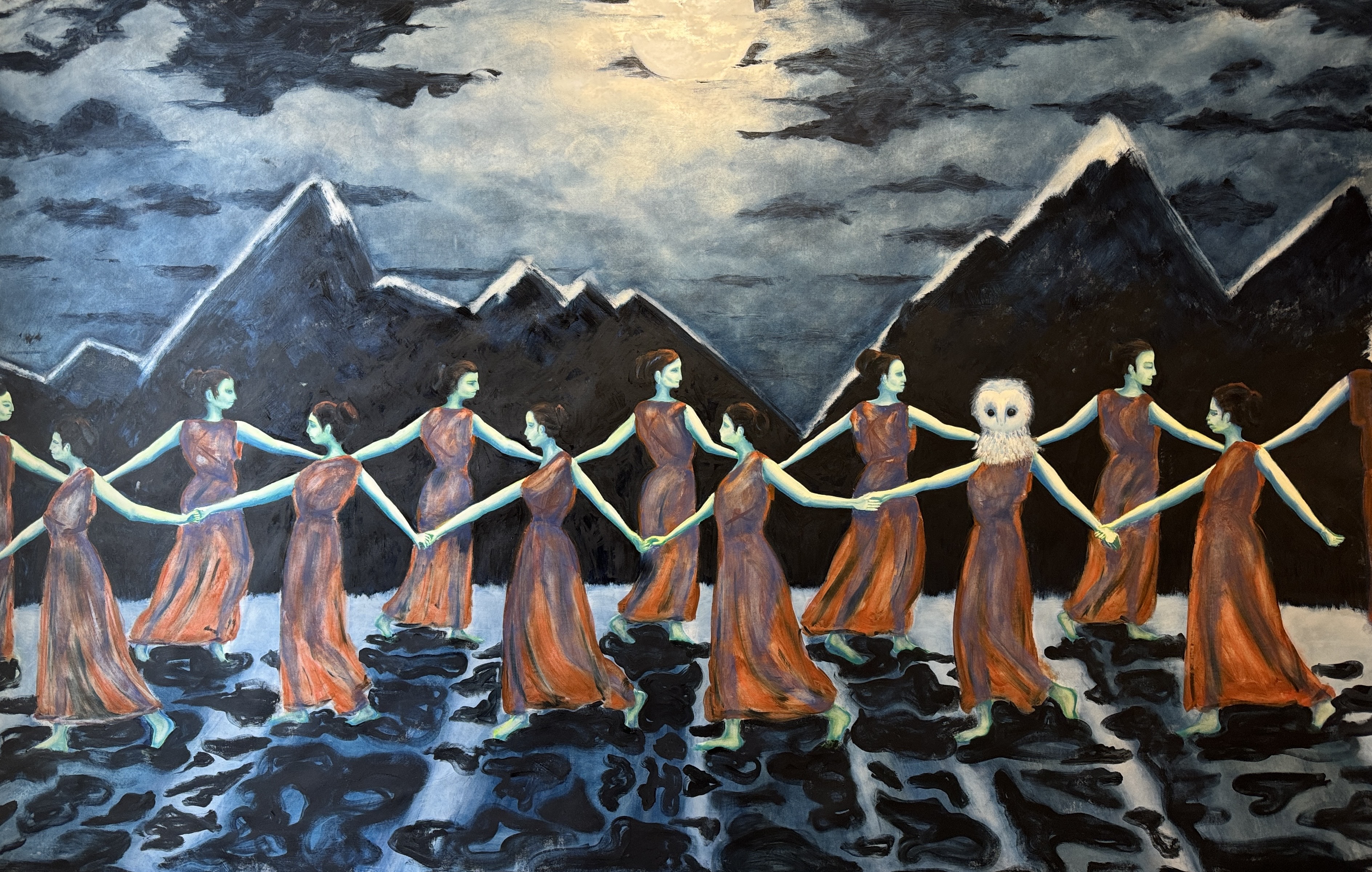
There is drama and lyricism in Jorgensen’s series of paintings entitled Passage to Zappeion, and also an intriguing sense of form and colour: Ancient Greek women dance in a circle, in the moonlight, in the work Dance; their red dresses contrast with the black mountains, while their white and blue arms create a criss-cross pattern that spans the centre of the painting. In the work With Yourself You Art Not Alone, the lime green flesh of the two figures contrasts with the light lilac and ochre skyscape behind them. Cloud forms are flattened into curving shapes that travel across the sky. Ochres, browns and purples create a mysterious atmosphere in the work The Mask is Off.

This is the work of an artist who has managed to enliven ancient tales and rituals via her fresh contemporary perspective and bold compositions, thus stating the fluidity of history. Past, present and future are merged into the moment of the art process that created these works, seeing as they also reflect on the artist’s imminent move to Athens, and in a sense explore her new future in the city of the heroic, wise, warrior goddess Athena.
Jorgensen studied art at London’s prestigious Central St Martin’s School of Art and Camberwell College of Art, and is a multi-disciplinary artist. However, it was her paintings at Art Athina that wowed the visitors, and one of them even got onto the front-cover of Athinorama magazine (the ‘Time Out’ of Athens).
Stella Sevastopoulos caught up with Mons Jorgensen to find out a bit more about her art and life, and what makes her tick as an artist. Her dynamic ambience was felt, while her blue eyes twinkled when she spoke of her love of ancient Greek literature, and her move to Athens. Read on to find out more:
– You exhibited at Art Athina this year, with Spazio b5 from Bologna. Your solo show there certainly attracted attention, and one of your works featured on the front cover of ‘Athinorama’. This series of works dealt with Greek mythology and the owl as symbol of Athena, combining this image with that of the bearded man of northern European fairytales and mythology. Tell us about these two pivotal figures in this body of work.
It was indeed a joy to be at Art Athina. It was the first time for the Gallery, Spazio b5, to be present in Athens. We were all made to feel very welcome, and to find a painting of mine on the front cover of ‘Athinorama’ was such a surprise!
The series of paintings we showed at the fair is called Passage to Zappeion. They were painted with Art Athina and an impending move of my family’s seat to Greece in mind. The paintings are a visual logbook of my creative journey exploring new connections and fresh sources of inspiration in Greece. I chose the owl of goddess Athena as my guide to examine my position as an artist in this new cultural space, whilst bidding farewell to the ‘bearded man’, who was a trope in my previous work and often appeared as a masked figure.
– Myth, magic, the absurd and even the surreal are elements that can be found in your paintings that were shown at Art Athina. They take us to a different world, yet at the same time they are contemporary works that use symbolism to comment on truths about human nature. Do you agree?
Yes I would agree, although I am not sure on that bit of ‘truths’. All these elements you mention, like the absurd, the surreal and the magic; I think they are all part of life, if we choose to see them; I, myself, am probably looking out for them. For me, it is all about catching fleeting thought associations and trying to capture them in a quick sketch. From there the ideas develop.
– The nature of the mask also plays a pivotal role in this series of works. In this case it is seen as a cultural mask. We need to adapt to our environment and wear different masks. Tell us your thoughts about the mask and how you have used it in your work.
I’m interested in the transformative power of the mask. We all play a game of hide and seek with ourselves and with others. Society is an eb and flow of withholding and revealing. You can become somebody or something else to others simply by putting on another face. There is also a transformative aspect that happens to the wearer him – or herself. You learn something about yourself. I think that is the core of our fascination with masks.
– I also love the colour schemes you have chosen in these works. Tell us about your use of colour. I get the impression that you use a limited palette very impressively, but with interesting colour combinations and contrasts, such as ochre and blue, or purple and warm browns.
This makes me smile. I get compliments on the use of colour quite a lot and it takes me back to being a teenager and being stuck between pencil drawings and ink drawings: everything black-and-white and maybe a bit of grey. I just could not decide how to use colour. I would always be disappointed with the effect; convinced I ruined the image. The use of oil paint finally resolved these issues for me. It is a very forgiving medium. So yes, I do think a lot about colour. For these paintings, I was aiming for a sun-drenched bright feel and blue skies to underpin the journey towards a more Mediterranean setting.
– There is a sense of humour or irony also in these works. Artists have to tread carefully in the realm of humour, do you agree?
I have been told that there is a sense of humour in my work. I’m not trying to be funny though. I simply paint who I am. Maybe it’s more the sense of happiness and positivity that shines through, rather than humour; I don’t know really. In general, I don’t think that paintings should make visual ‘puns’; that would get tiring very soon.
– You work between London, Olympiada and Athens and will be moving to Athens soon. That’s an interesting triangle of cultural influences, to which of course there is also added your own Dutch roots. How have these different cultures influenced your art?
I struggle to answer this question because there are so many influences and periods in your life and people and books and different languages that it becomes difficult to isolate the strands. I do think that when you grow up in a dual nationality family, as a child you already naturally position yourself somewhat outside of the ‘home-culture’. I have a Dutch mum and a German dad and grew up in Rotterdam. I learned very early on to look in from the outside. My husband is Danish/Greek and he has subsequently introduced me to both cultures. We have lived in both countries for a while, but all our summers are spent with the family in Olympiada. Still, to holiday in Greece is a very different thing from working. I initially took the landscape as my inspiration, but the resulting imagery resembled a carte postale. A lot of imagery in Greece is ‘taken’ so to speak.
– You mentioned when we spoke at Art Athina that you had studied ancient Greek at school, in Holland. Are there any texts/ancient Greek literature that have stayed with you? The Dance paintings where ancient Greek women are dancing in a circle, are a beautiful perspective on ancient Greek theatre and rituals.
I was very lucky to receive a classical education at the Erasmiaans Gymnasium in Rotterdam; probably the most forming experience in my life together with rowing at uni. My translation skills are very disappointing after having spent so much time with these languages, but the content has stayed with me. The farewell of Hector to his son Astynax springs to mind. This section had me silently in tears behind my cahier in the classroom. Such a simple section with so much meaning. So, yeah that stayed with me, the storytelling. I also love some of the modern retellings of the ancient myths, like Kassandra by Christa Wolf. Or, more recently, Circe by Madeline Miller.
The painting Dance loosely incorporates elements of folklore dance on the village square, witches dancing by night and the chorus in Greek plays. The power of women and the collective and the concept of circular events, ever returning.

– You studied at Camberwell College of Arts (BA) and Central Saint Martins (MA). But before that you had also studied Governance and Global Affairs. So, what made you take the art road?
When the choice came when I was 17 to choose my studies, I knew I wanted to study art. Unfortunately, I simply was not brave enough to tell anyone and there was also no indication at all that I was an artist. You know, how sometimes at school students’ work gets hung on the wall as an example? Well, never my stuff. I was very private and kept these dreams too close to my heart. So, that is how I pursued an MA in ‘Bestuurskunde’ at the University of Leiden. I would say that it is an excellent preparation for being an artist. We were trained to analyse complex social issues, to find the different perspectives.
– You are a multi-disciplinary artist, who has created video art, installations, prints, but also paintings. Would you say that in recent years you have gravitated more towards painting?
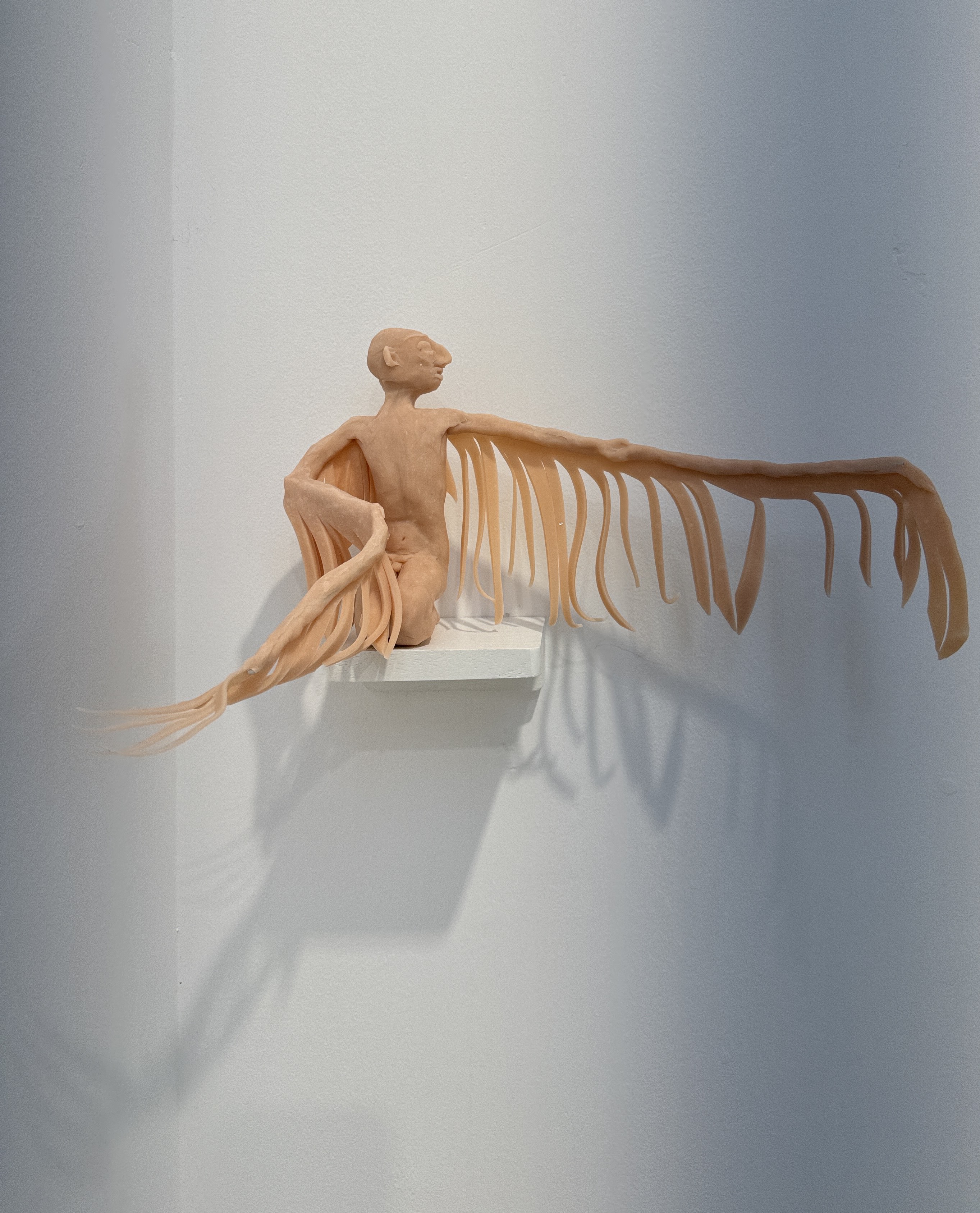
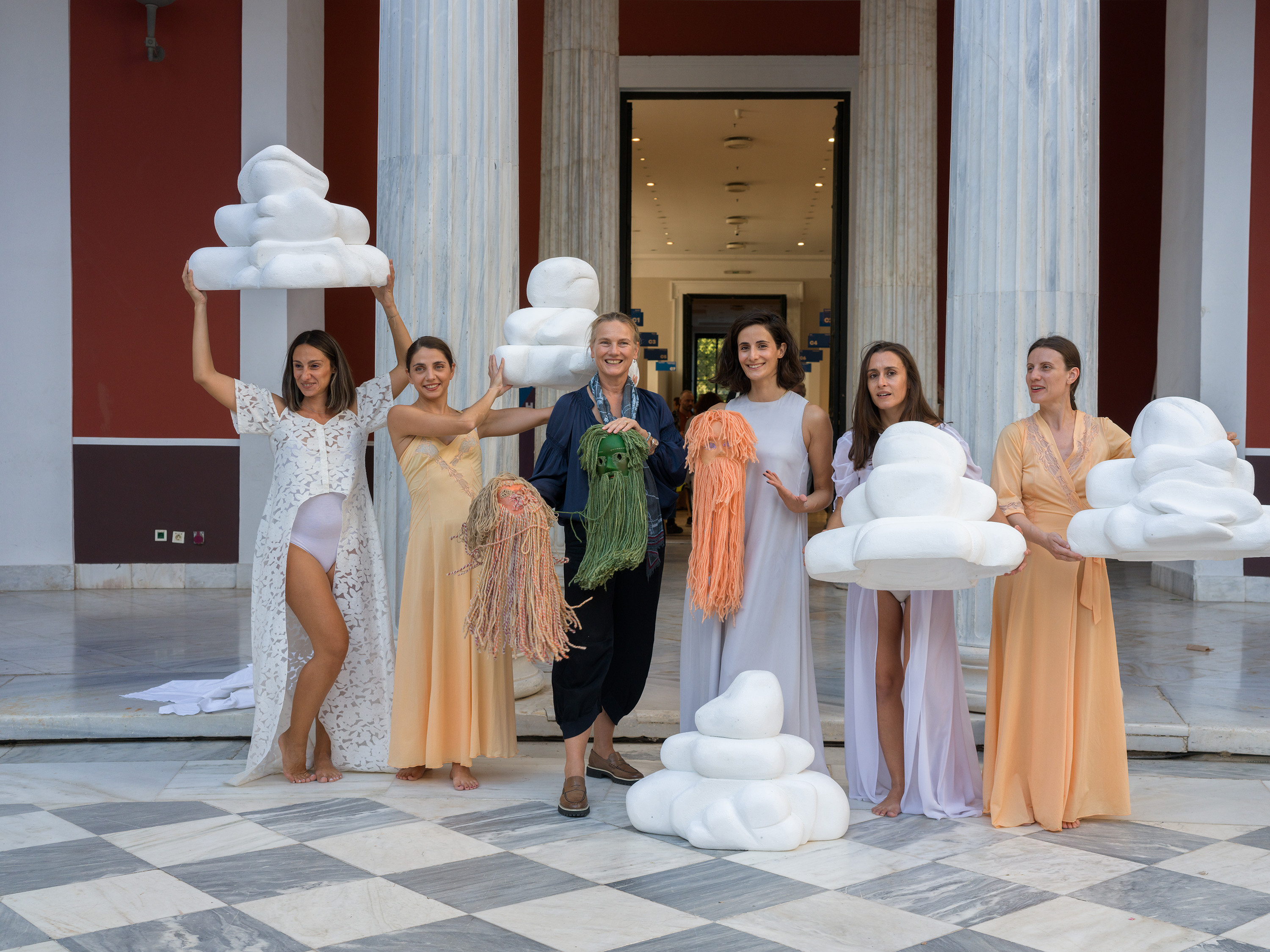
My solo exhibition at Spazio b5 in Bologna this year featured sculpture, photography, video-installations and crayon drawings. In Athens I showed paintings and small figurines and for the performance that took place at Art Athina, the actors used my masks and clouds as props. I don’t think I am in a process of leaning more towards painting, but for the aim of this exhibition 2D suited me well. I worked mainly through my sketchbook towards the development of a new visual language; a shift from Northern towards Mediterranean European context in my work.
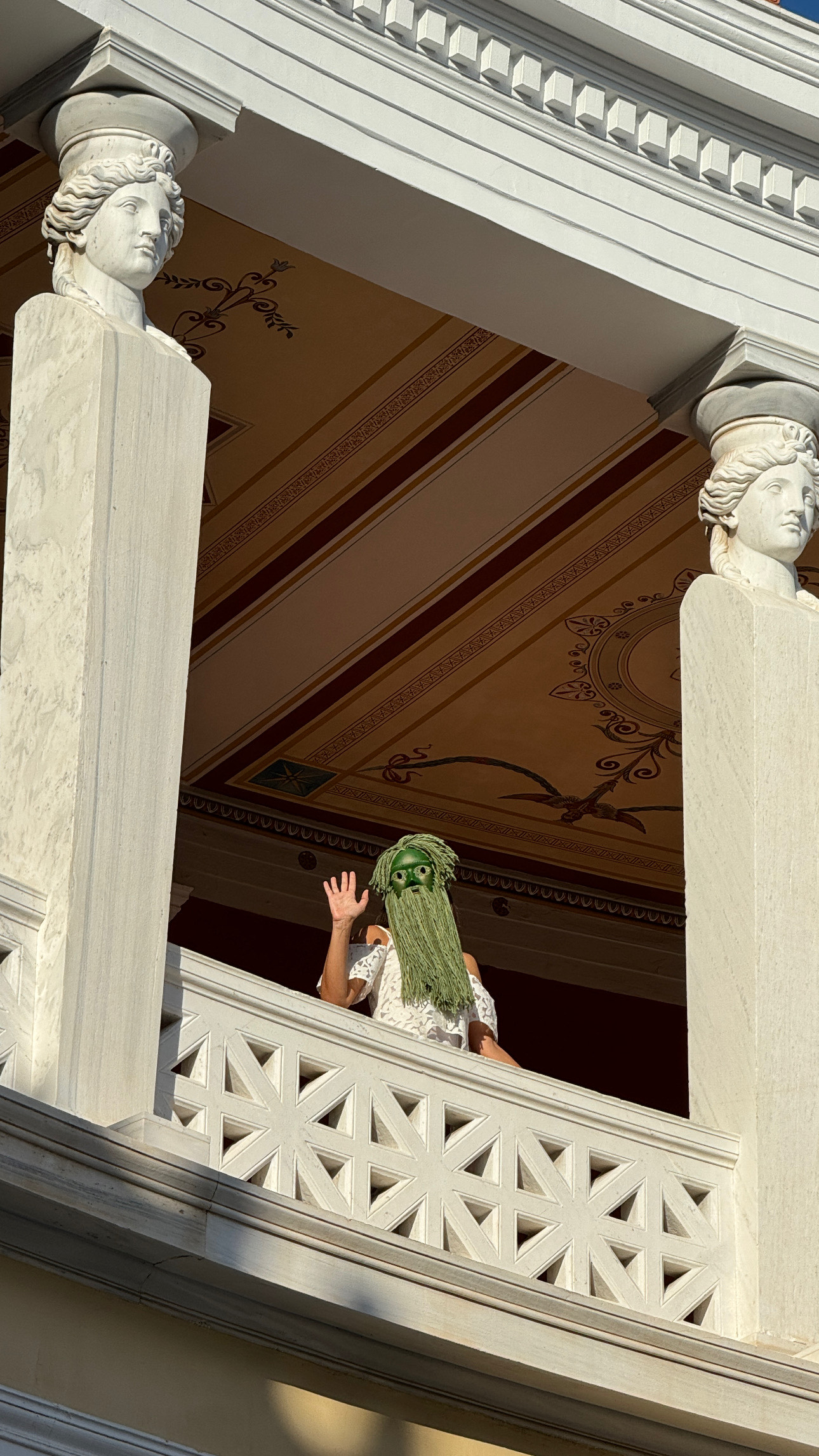
– When we spoke at Art Athina, you commented on the melodramatic nature that you see in Greeks, even in the way that they write about art. How else would you characterize the Greeks?
I wouldn’t want people to be upset with me, using the term melodramatic. Perhaps ‘lyrical’ would be the better term. In my mind it is a positive thing: the flare for drama and exaggeration. It is all about the storytelling.
– How was your experience of Art Athina?
Art Athena was a fantastic experience. We were made to feel very welcome, and we had an absolute blast. We also learned a lot and now that we know more about the space itself, the logistics and the organization, we can prepare better next time.
– What is planned next? Where will we see your work? Are you working on something new?
I am still enjoying developing this new iconography in my work. I plan to spend time in my studio at Kindred Studios in London over the winter. I probably also will need to dedicate some time to organise our move to Greece. For this reason, I haven’t committed to any shows. The future is a foreign land!
- To find out more about Mons Jorgensen you can visit her website here
 art scene athens