THE EXHIBITION of works by Achilleas Christidis on show at the City of Athens Art Gallery, is an ode to bountiful painterliness and maximum impasto. Entitled “Painting Landscape”, this solo show runs till February 23, is curated by Christoforos Marinos, and is supported by the City of Athens Culture, Sports and Youth Organization (OPANDA). The works form a retrospective of sorts, focusing on Christidis’s landscapes from the past 20 years (2004-2024). However, there are also some large-scale portraits and small-scale flower paintings included. What isn’t included is Christidis’s earlier, more surreal paintings, but that would be going back even more years, although it would have been an interesting take off point for the exhibition. Nevertheless, elements from this earlier period do sneak into some of these landscapes, adding yet another layer to them.
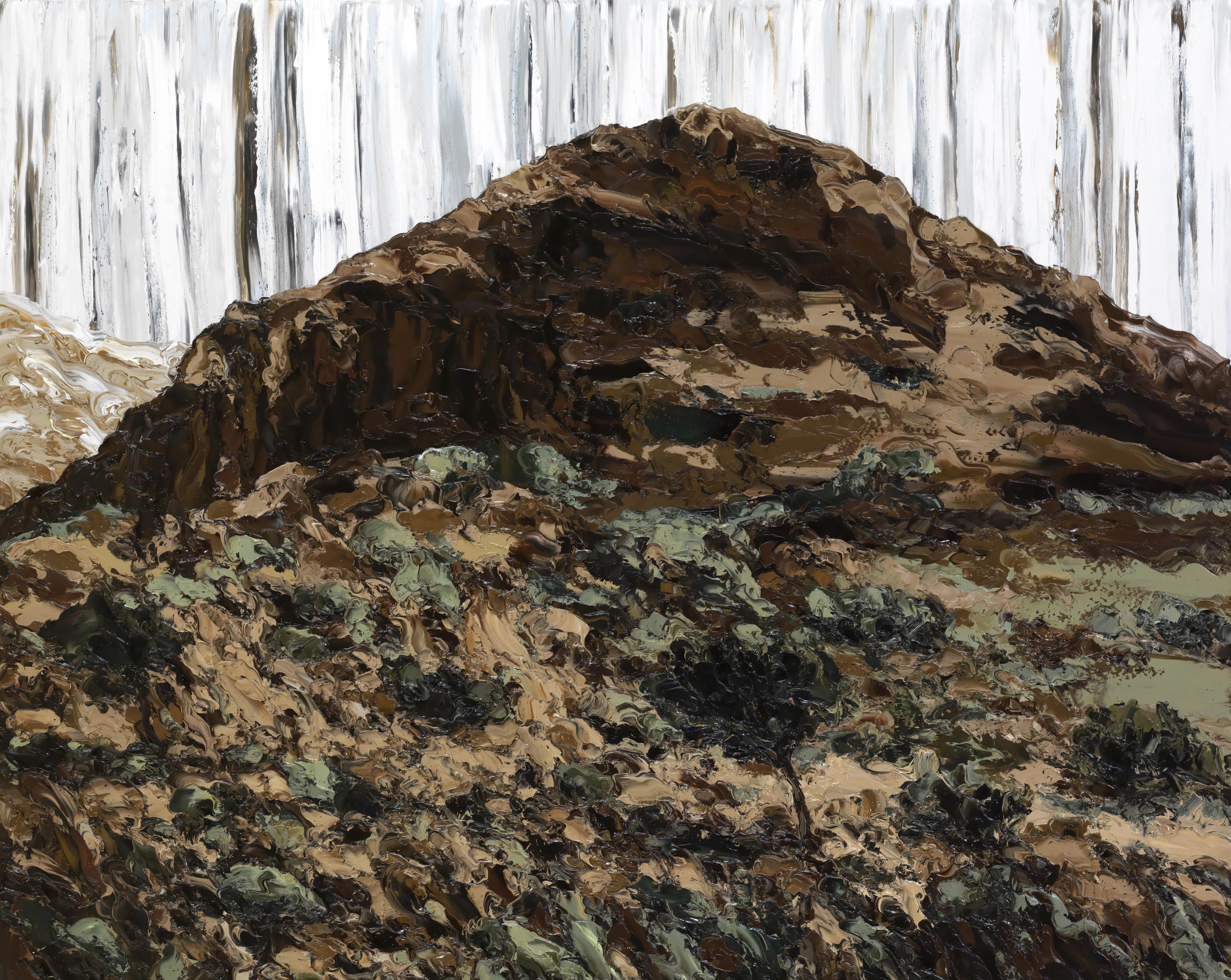
Christidis is an artist who is unafraid of the gesture, of mark-making and of unleashed expressionism. The thick lashings, layers and globs of paint bring to mind Anselm Kiefer, while the portraits seem to wink at Vincent Van Gogh. However, as stated in the exhibition’s text, it is to the Greek masters Nikolaos Lytras and Thanos Tsingos that Christidis takes his hat off. The thickness of the paint-marks allows Christidis to mould them, emphasizing their textural and sculptural quality, and making one wonder how many tubes of paint have been used, yet also to marvel at the generosity involved in this artistic process.

Christidis has honed his own form of expressionism, one which travels towards the abstract a bit more in some paintings than in others. Yet in many of these works (all of which bare the title of ‘Untitled’), there seems to be a fight between the abstract and the representational, which often takes place between the land and the sky: for example, in one landscape, the serene and golden fields, are capped with a sky full of colour that has been scraped across it, accompanied by other gestural mark-making. In this case, Christidis makes us realise how the sky is often an abstract painting in itself. In another work, which seems to depict the cityscape of Athens, with Lykabettus Hill in the distance, the sky’s clouds have been depicted with such a frenzy of marks, that they look like they are caving in on the city. Furthermore, they look heavy, like the marble blocks or boulders used to carve sculptures or columns out of. In the text for the exhibition, Christoforos Marinos states that “A sky may become an abstract composition, a second painting within the painting”.

It is the interplay, union, division or even battle at times, between the abstract and the figurative in these works which is so compelling. Sometimes the land is accompanied by an abstract painting for a sky, however in another work, which focuses on a tree by water, the tree’s branches speak of poetic classical figuration, while the water is an abstract entity in itself. In this case, the abstract and the figurative compliment each other, despite their differences, and the artist challenges us to find the point where the figuration stops and abstraction takes over. In other works, the division is blurred and blended, such as in the depiction of a mound of earth for example, in which you may trace what could be faces or even skulls (after all, what is earth but the decomposition of all things).

In the exhition’s accompanying essay, curator Christoforos Marinos says the following: “Imagine a landscape painted with scripts and signatures, reminiscent of street artists’ tags – a rocky landscape rendered in black, white, and shades of brown. The earth dominates the scene, with a sliver of sky above – nominative, indifferent almost. Yet, without this thin strip of light, composed of white, a hint of blue, and scattered brown markings, the landscape would not exist. Though incomplete, the stained, soiled sky completes the landscape, composing a cryptic Landscape. Upon closer inspection of the earth’s surface, hidden faces, illegible words, indecipherable phrases emerge. It’s a landscape constructed of words, a linguistic landscape.” This is especially evident in Christidis’s cityscape which includes the Acropolis in the distance.

Also interesting is the way that Christidis has played with gloss and matt surfaces. Many artists prefer to have just one unified surface – that being the more mainstream approach. And certainly, for many of these paintings this is the case. However, there are some works in which Christidis has decided to alternate between gloss and matt, creating interesting highlights in this way, such as white fluffy clouds that glisten in a matt sky.
Achilleas Christidis was born in 1959 in Piraeus. He studied stage design and music; his work also spans ceramics, photography, constructions, and book illustration. A self-taught painter, he has held over fifty solo exhibitions throughout his career. He currently lives and works in Athens.
- The exhibition “Painting Landscapes” opened on Thursday, January 9, and runs till February 23. Opening hours: Tuesday to Saturday 11:00 AM-7:00 PM | Sunday 10:00 AM-4:00 PM. City of Athens Art Gallery, Leonidou & Mylleros, Avdi Square, Metaxourgeio, Athens. Nearest metro station: Metaxourgeio. For more info: 210 5202420. You may also visit the site of OPANDA here

Art Scene Athens’ is written/run by artist/journalist Stella Sevastopoulos. Dedicated to presenting what is happening on the Greek art scene (but not only), and also to giving Greek artists (and artists based in Greece) an international voice on the internet. For more on Stella Sevastopoulos’s art, click here If you would like to be featured in Art Scene Athens, please send email (stelsevas@yahoo.com).
 art scene athens