THE MUNICIPALITY OF ATHENS and the City of Athens Culture, Sports and Youth Organization (OPANDA) present the solo exhibition of Eleni Krikki, at the Melina Cultural Centre. The exhibition, curated by Christoforos Marinos, runs till February 16, and is titled Ma (which in japanese means ‘negative space’). The exhibition comprises works by the artist from 2017 up to the present. In his text for the exhibition (translated into english by Dimitris Saltabassis), Christoforos Marinos states the following:

In Eleni Krikki’s art, threads weave landscapes, morphing into memories, and geography is imbued with the artist’s intimate emotional bond with the world of fabric. Her colourful ‘topographical’ weaves are primarily ‘ancestral landscapes,’ stemming from her childhood, from a distant, primal source, from locations and recollections that have left a vivid imprint on her consciousness and, by extension, her artistic practice. ‘For me, they are kinship bonds with my past and my heritage,’ the artist states about her dyed and embroidered fabrics, filled with stitches of vividly coloured threads.
Raised in the vast Thessalian plain and the old-growth forests of Pindus, with a father who was a fabric merchant and a mother who spent her free time embroidering and knitting, Krikki experienced firsthand the healing power of needlework. She absorbed, in her own unique way, practices and techniques associated with the culture of textiles and knitting. As a child, she would watch seamstresses with admiration, play with scraps of fabric, and see women in the mountains of Pindus dyeing threads in cauldrons on earthen surfaces to avoid staining their homes. She recalls ‘colourful carpets draped over stone fences to dry, courtyards with looms, walls layered with coats of coloured limewash – where indigo emerged through ochres and pinks – interiors adorned with woven fabrics and embroideries, rugs on the floor and tapestries on the wall beside the bed or headboard.’
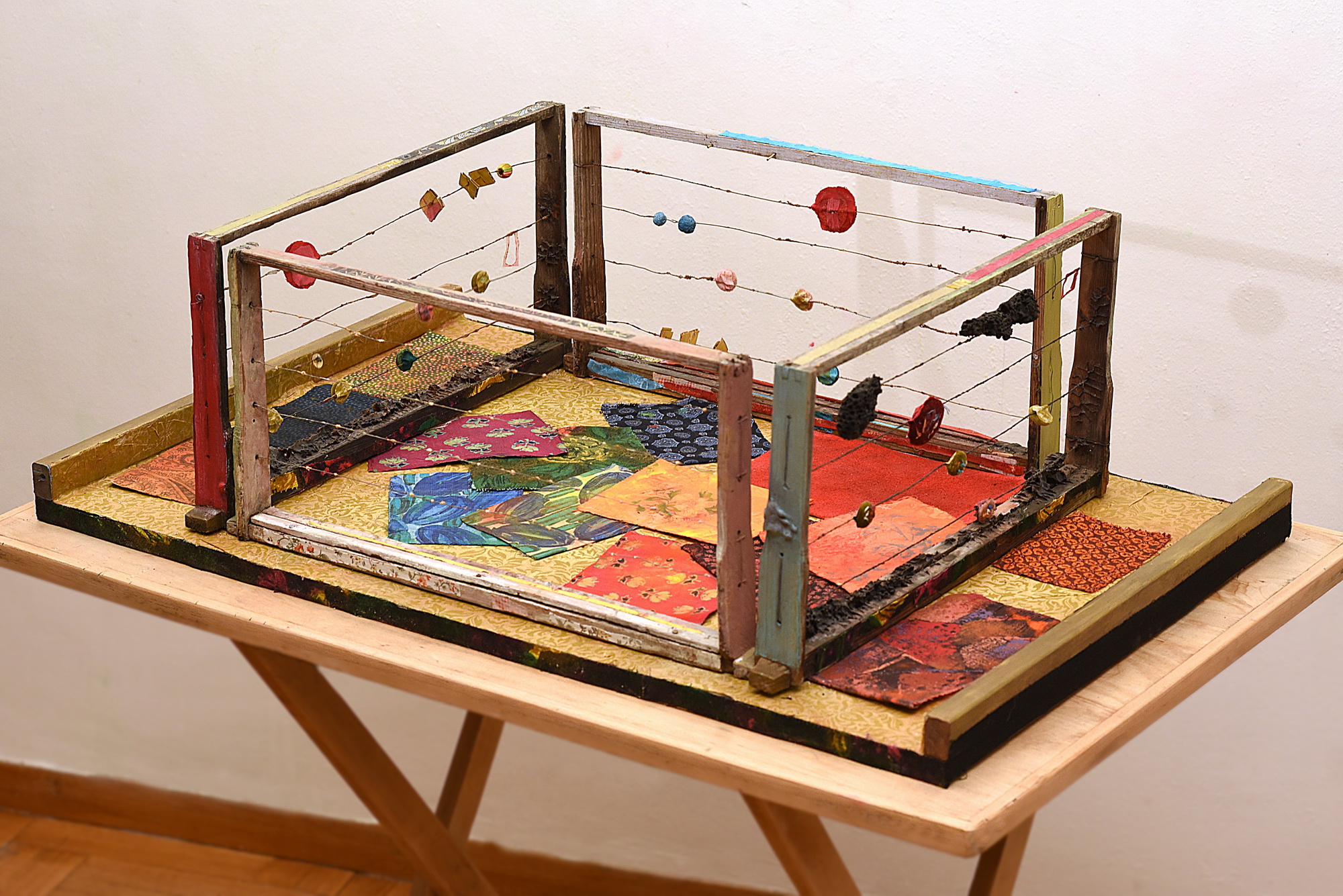
Her love of mathematics and her studies in architecture are evident in her artwork: in wooden, plaster, and fabric abacuses; in her ‘personal geographies’ – works that evoke expanses, maps, and topographical renderings, equations and musical scores; and in spaces created from wooden, wire-framed honeycomb structures. In her wall-mounted fabric compositions and installations, realism coexists equally with the metaphysical; the sciences with the humanities; and the conscious with the unconscious. The titles of her works (Desire, Expectation, Persephone, Imprints, Folds, Coordinates, Mural, Then) suggest a cartography of emotions and memories. Winter underscores the importance of the seasons and the year cycle, as does Polychrono, a celebratory composition incorporating multiple temporalities. Conversely, Byzantine, made with fabric, paint, and light, is a nod to the past, a space for meditation and prayer.
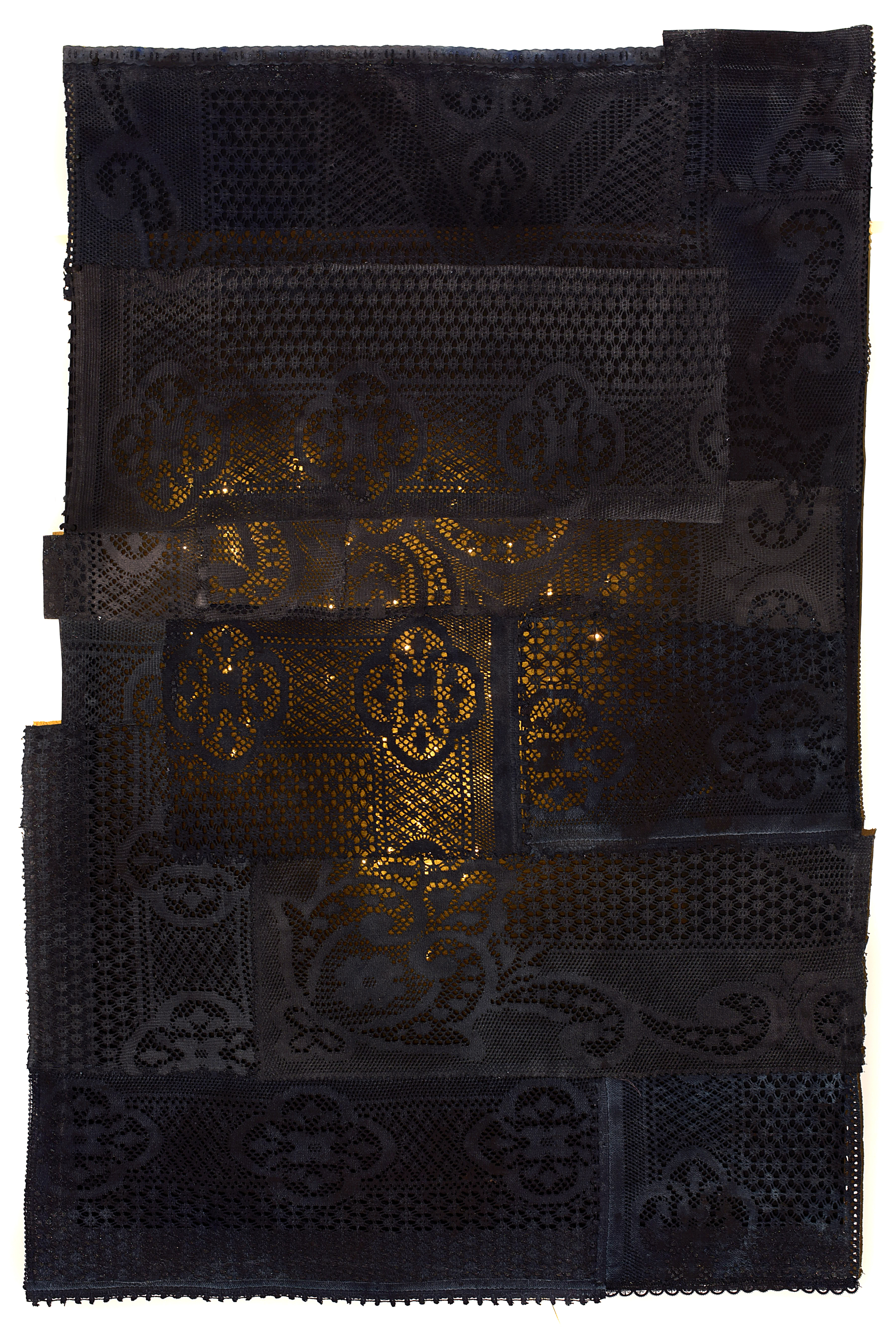
Krikki’s works ‘fall and flow’ like water or precious tears. She uses fabric pieces that she dyes, paints, and embroiders with tight or loose stitches. Bound together with paper, plaster, and glue, her creations hang freely in space, revealing both their front and back sides. These multicoloured, medium- and large-scale compositions unfold emotional recordings and impressions, ‘unions of life fragments inscribed on fabric.’
She selects fabrics for their colour, texture, and pattern. After dyeing them, the drying process influences their final form: laying them flat results in near-monochrome surfaces, while folding them on a horizontal plane produces unique patterns and a colour palette of varying shades of blue or green. The fabrics are then ironed and reinforced with interfacing – material used by seamstresses – to make them sturdier and less prone to wrinkling. This entire process is an exercise in polychromy through dyeing. The compositions vary: some include written elements, while others resemble masonry with visible joints. ‘These aren’t just colours; they are a kind of psychic energy,’ the artist emphasises, with the word ‘rhythm’ recurring in her reflections.

Her fabric compositions, abacuses with rows of prayer beads, talismanic embroideries, and prayer rugs are complemented by old chests filled with countless fabric scraps, which she describes as having ‘immense intensity’ as they form the source material for her work. Some of these embroidered scraps are placed on a mirror, resembling photographs of loved ones – objects we need to keep close to us and greet daily. Like Japanese gardens, where the pruning of trees highlights the importance of empty space, so too does the space between Krikki’s fabric ‘photographs.’ This emptiness, which invites the gaze to encompass both the present and the absent ones, proves to be essential. ‘I find myself often in this void, in the Ma,’ says Krikki. ‘I know life, I have seen death, and I understand the in-between, which has so many qualities, including metaphysical ones. It is the void that is not empty – a web of unseen connections, a place of energies, both real and metaphysical, the threshold between two worlds. Incidentally, Ma is also half the word for ‘mother’ in Greek.’
In the ‘Ma’ exhibition, negative space holds equal significance, drawing viewers into closer contact with Krikki’s ‘topographical weaves,’ which now take on the form of a unified installation. Through this void, one perceives the transparency that leads to life, the imprints, the black and the red, the light that comes from somewhere far away yet coexists with the darkness, the equations of eternity, the mourning expressed in a laid carpet grounding one to the earth. You hear the sound of chimes, imagine a swing suspended in space, and recall – never to forget – a passage from Roland Barthes’s Mourning Diary: ‘Maman: (all her life): space without aggression, without meanness.’

Eleni Krikki bio:
Born in 1962 in Trikala, Eleni Krikki studied Physics at the National and Kapodistrian University of Athens and Architecture at the National Technical University of Athens (NTUA). She also attended sculpture seminars at the N. Perantinos Sculpture Museum. Member of the Chamber of Fine Arts of Greece. She lives and works in Athens, where she maintains her studio. She has mounted numerous solo exhibitions, including at the City of Athens ‘Angeliki Chatzimichali’ Museum of Folk Art and Tradition (2016); Pontoporos Gallery in Paros (2014); Horos Technis 24 (Art Space 24) in Athens (2013); the Cultural Centre in Mytilene (2011); Astra Gallery in Athens (2008); Kouros Gallery in New York (2006); the Castle Clock Tower in Trikala (2004); Ermoupoleia in Syros (2003); and Logos kai Techni in Lefkada (2002), as well as Diavasi in Athens (2002); she has participated in Art Athina three times and taken part in numerous group exhibitions of painting and design; and most recently joined ‘Rebetiko’ at the Vassilis Tsitsanis Museum – Research Centre in Trikala (2024) and ‘The Inner Side of the Wind’ at the Chryssanthopoulos Mansion in Pyrgos Kymis, Euboea (2024).
- The exhibition Ma, with works by Eleni Krikki, runs till Feb 16 at the Melina Mercouri Cultural Centre, on Herakleidon 66 & Thessalonikis Streets. Nearest metro: Kerameikos. Open Tues to Fri 11.00-19.00, Sat and Sun 10.00-15.00. Closed Mondays. Tel: 210 3414466. For more info you can also visit the OPANDA website here
Art Scene Athens’ is written/run by artist/journalist Stella Sevastopoulos. Dedicated to presenting what is happening on the Greek art scene (but not only), and also to giving Greek artists (and artists based in Greece) an international voice on the internet. For more on Stella Sevastopoulos’s art, click here If you would like to be featured in Art Scene Athens, please send email (stelsevas@yahoo.com).
 art scene athens