THE MUNICIPALITY OF ATHENS and the City of Athens Culture, Sports and Youth Organization (OPANDA) have organised a large retrospective of the work of Babis Retzepopoulos (1940-2002), which runs till May 25. Afterwards, the exhibition will travel to Tinos, to the Foundation of Tinian Culture (June-September). Retzepopoulos cuts an interesting figure in the world of Greek art history, and his prints in particular to this day, are marvelous translations of reality into a black-and-white perspective. Christoforos Marinos has curated the exhibition, and has written the following text about the artist:
“The painter, printmaker, and graphic artist Babis Retzepopoulos was born at a time when light was battling darkness. He came into the world on 27 December 1940, in Athens – two months after the outbreak of the Greco-Italian War and shortly before his country was occupied by Axis forces. This archetypal duality – light and darkness, light in darkness, the journey from darkness into light – would become the backbone of his creative thought and practice.
From his earliest paintings, Retzepopoulos impressed with his mastery of colour and, above all, his willingness to experiment. His compositions are well-crafted, solid, and multi-layered, much like the prints he would later create. Looking at his paintings from 1960–63, one might say that this young artist treated human figures like still lifes and still lifes like living entities. In his purely abstract “Composition” (1961), which won first prize at the “October Exhibition” at Galerie Techni, Retzepopoulos expanded his artistic horizons, shedding figuration and the logic of representation. In the years that followed, he applied himself almost exclusively to printmaking, graphic design, and the decoration of commercial spaces in Athens.
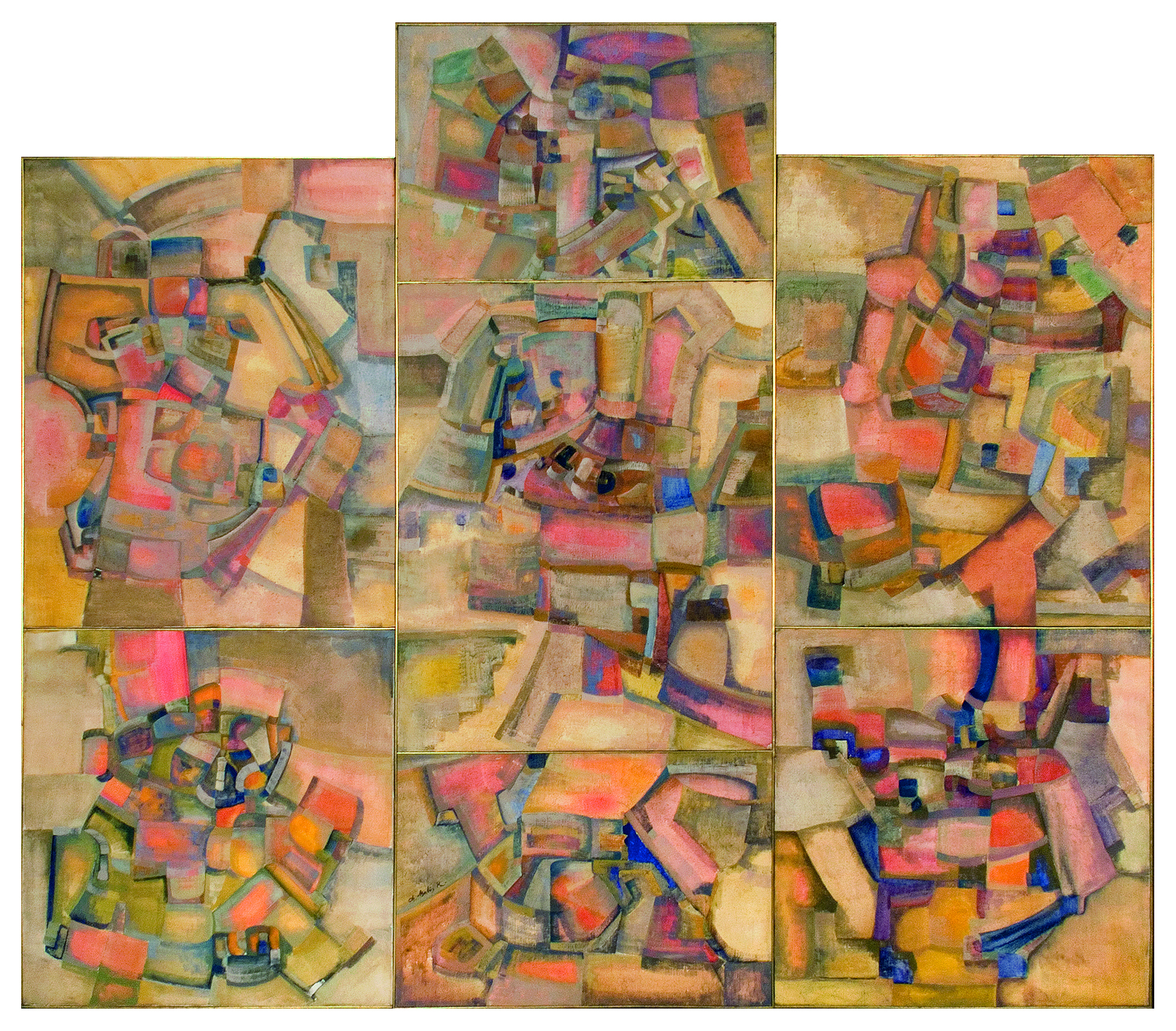
When he returned to painting, during his time living in Paris (1967–73) now signing his works as “Ch. Babis R.”, his compositions differed significantly from those of the early 1960s. His palette became softer, while his focus shifted towards the movement of volumes and the relationships they formed – how they interpenetrated, creating depth and the illusion of three-dimensional space. These works resemble schematic city maps. At the same time, titles such as “Serious Song” and “Winter Journey” – likely references to Brahms and Schubert, respectively – reveal the connection between his paintings and classical music.
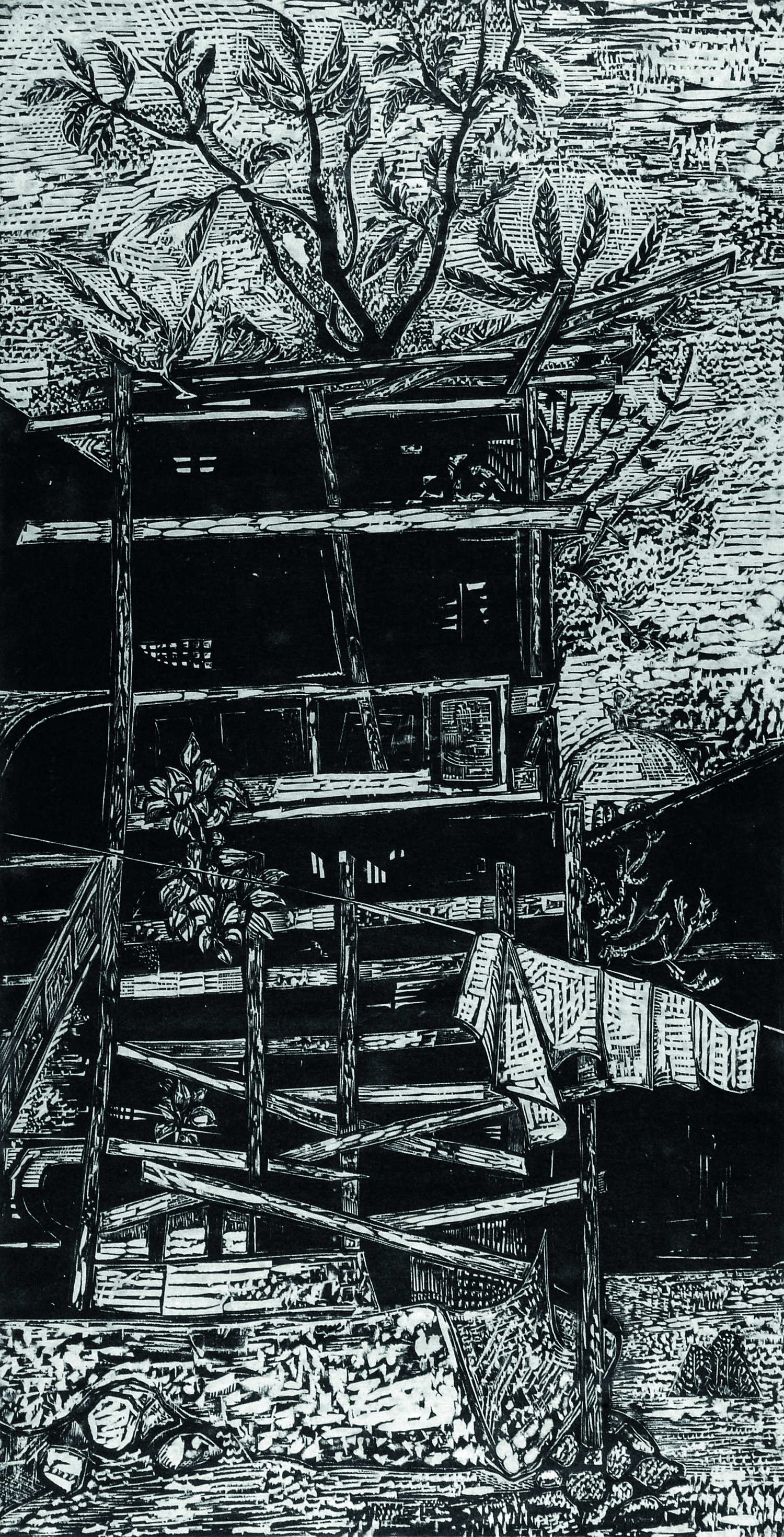
Of the woodcuts he created while living in Athens during his studies at the Doxiadis School and beyond (1962–67), around twenty are known to us. During his time in Paris (1968–73) and in the early years of Greece’s post-dictatorship period (1975–78), after settling on Tinos, where he ran the “To Magazi” gallery with Lefteris Kritikos, he produced forty more figurative woodcuts. Some of his Parisian works, such as “Composition Y” (1970) and “Theme B” (1972), bear similarities to his early paintings, reflecting a similar expressionist sensibility. The viewer’s gaze cannot settle on a single focal point but instead moves across the different layers formed by black and white, light and shadow. Some prints are enigmatic, such as “Print for the Blue Friend” (1967), while others have a more traditional and accessible quality, being less complex. On Tinos, in particular, Retzepopoulos seems to simplify his compositions, seeking essence and immediacy.
Retzepopoulos’s printmaking developed a new and more profound relationship with light when, in the late 1980s, he adopted an abstract approach – a bold, original technique distinguished by its poetic quality. He located trunks of ancient olive trees and used their perforated cross-sections as printing blocks, meticulously smoothing their surfaces beforehand. This departure from traditional pear or linden wood blocks and from carving directly into the wood prioritised chance over control. Printing on large-format sheets of paper, reaching up to 150 centimetres in height or width, he created six distinct series over a five-year period. Even here, his primary inspiration remained music – or, more precisely, he sought to connect his work with classical compositions, such as “Theme and Variations” by Johannes Brahms.
A defining characteristic of Retzepopoulos’s abstract prints is their interplay of light and darkness – between the black of the printed form and the white of Japanese paper. Here, printmaking becomes a game, a variation on a theme. He almost always combines two olive wood blocks on the same surface, creating pairs. Only in the “Form” series and “Dance I” does he print with a single block. In “Surface Trunk”, this experimentation reaches its peak, as he employs seven different blocks, arranging them in two pairs, four triads, and one quintet, whilst one large print includes all seven. In doing so, he highlights the negative space between the forms, which generates new shapes and spatial relationships equally crucial to the composition.
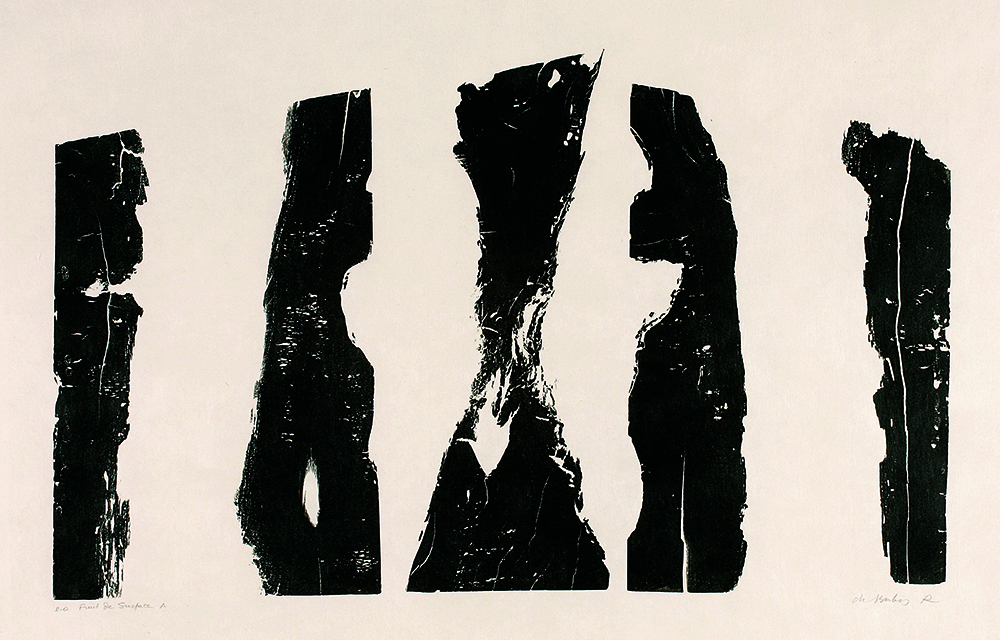
Like the mythical phoenix rising from its ashes, like the olive tree persisting and blooming amidst ruins, these forms are everlasting, capable of infinite reproduction. They showcase, in the most striking way, both the fundamental essence of printmaking and the boundless possibilities the medium offers in the hands of a visionary artist who refuses to follow convention.
What might A. Tassos (1914–1985) have thought had he seen the abstract prints of his gifted pupil? The renowned printmaker, too, depicted tree trunks in 1950 (two anthropomorphic olive trees that appear to be dancing) and again in 1980–81, in an impressive large-scale woodcut mural (550 × 350 cm) for a Credit Bank – now Alpha Bank – branch in Thessaloniki. Like most printmakers, Retzepopoulos also created a woodcut with a similar theme (“Trees”, 1968). However, the difference is that in his abstract works, he does not simply depict trunks – the tree is not the sole subject of the work. In his hands, the wooden trunk becomes a stamp, a means of expression, a representational tool, and a source – a metaphor for the body, for the relationship between printmaking and music, dance, and grief. These works, which celebrate the colour black at a time when colour reigns supreme, bring printmaking closer to painting, revealing its expansive nature.”
- Opening hours: Tuesday to Saturday 11:00 AM-7:00 PM | Sunday 10:00 AM-4:00 PM. City of Athens Art Gallery, Leonidou & Mylleros, Avdi Square, Metaxourgeio, Athens. Nearest metro station: Metaxourgeio. For more info: 210 5202420. You may also visit the site of OPANDA here
 art scene athens