PACE Gallery and The Intermission are pleased to announce a collaborative survey exhibition of works by Greek-born American artist Lucas Samaras, opening on Thursday, September 25, 2025, at The Intermission’s exhibition space in Piraeus, Greece. The exhibition, titled Master of the Uncanny, will be the first solo presentation of Samaras’s work in his birthplace since his retrospective at National Gallery–Alexandros Soutsos Museum in Athens twenty years ago and will bring together works spanning his expansive and protean practice. It will also celebrate a nearly six-decade relationship between the artist and Pace, which has represented him exclusively since 1965.

Born in Kastoria, Greece, in 1936, and immigrating to the United States in 1948, Samaras created a groundbreaking body of work spanning sculpture, photography, painting, digital media, and wearable art. His practice profoundly interrogated selfhood, memory, and transformation, often using his own body as subject—a focus shaped in part by his involvement in the Happenings, a hybrid art form combining installation, performance, and other mediums, staged on New York’s Lower East Side in the late 1950s and early 1960s. A key figure in the city’s mid-20th-century avant-garde, Samaras embraced this cross-disciplinary context to forge a singular path. In the decades that followed, his work consistently resisted easy categorization as he moved fluidly across figurative pastels, assemblage boxes, immersive mirrored rooms, Polaroid self-portraits, psychedelically colored paintings, and pioneering digital works.
The exhibition at The Intermission will feature works made between the 1960s and the 2010s, including rarely exhibited sculptural jewelry. Examples of Samaras’s manipulated photographs from the late 1960s and early1970s—the Auto Polaroids and Photo-Transformations—will be on view, alongside a selection of chromatically dense Mosaic Paintings, fabric Reconstructions, and pastel works on paper. A suite of sculptures, including examples from the artist’s Box series and other “transformed” utilitarian objects, will also figure.
The art historian Thomas McEvilley described the course of Samaras’s varied oeuvre “less as a linear sequence than as a concentric series of layers.” He continued: “It is not that his genres have evolved so much as that they have expanded. His oeuvre displays both a relation to changing art historical moments and a sense of the organic, of being a body that grows into itself without ulterior motive.” Despite the many iterations and inventions in his career, Samaras consistently engaged with his own image and psyche. “Some artists reject autobiography and psychology,” he said. “I try to keep them with me, no matter how embarrassing they are.”
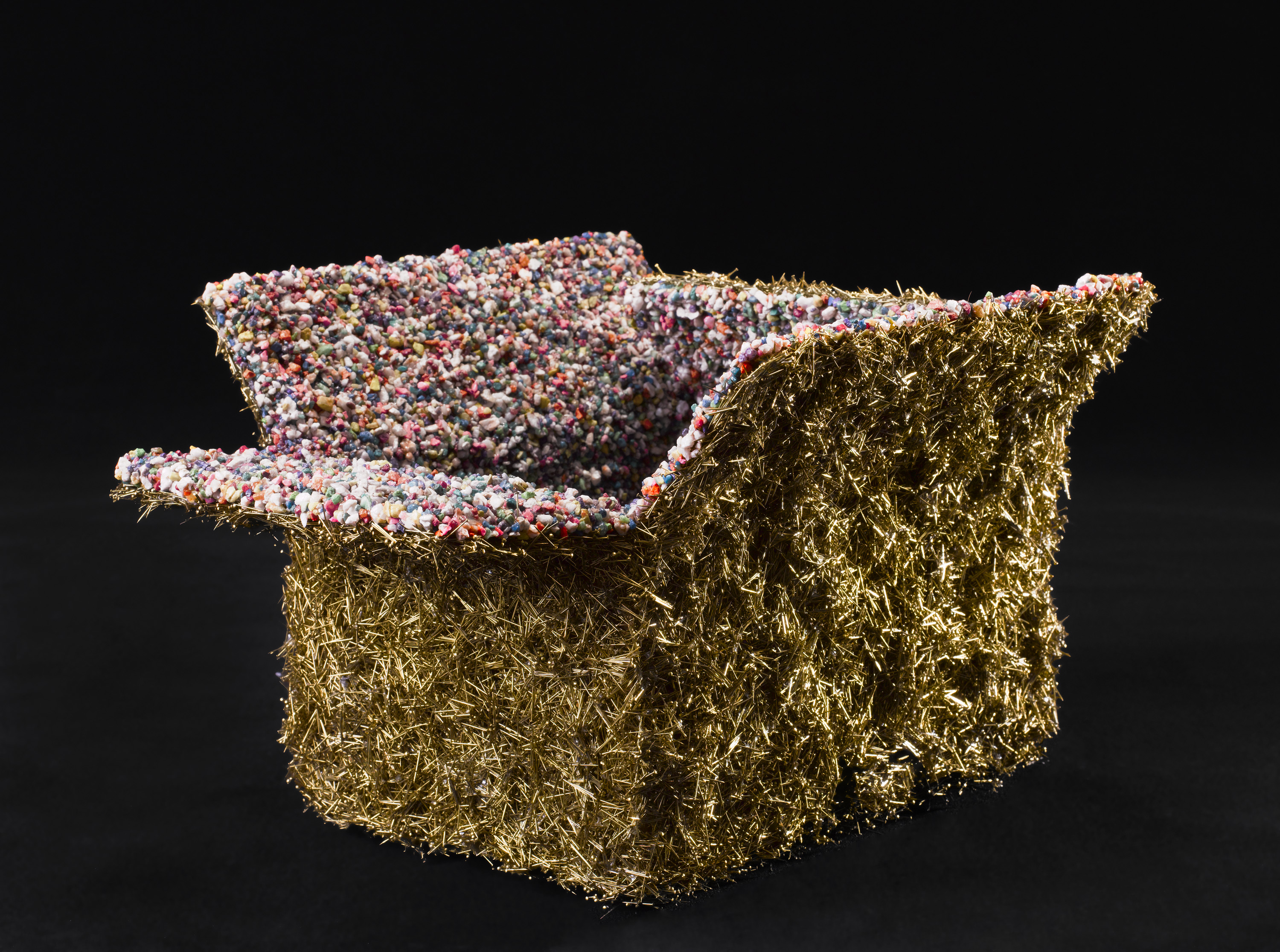
Three of Samaras’s intricately designed boxes, as well as a1974 chicken wire box, will feature in Master of the Uncanny. These works, often containing ephemera and photographs, functioned as three-dimensional spaces into which the artist could project himself. His early boxes carried an aggressive edge, evocative of Surrealist objects with blades or pins piercing their surfaces. Over time, however, Samaras shifted from sharp and hostile materials toward softer ones. “I’m always going to be an attacking artist partly because I’m of a different culture and I have to defend what I came with,” he remarked. “But you can threaten people in different ways.You can use color, or glittering stones, or you can offend their Puritan tastes by over-elaboration.”
Around the same time that he began making the boxes, Samaras introduced photography into his practice, initially embedding his images within the sculptural containers. He soon embraced the Polaroid camera, making photography an autonomous medium within his work. Using unconventional poses, camera angles,and colored lighting, and staging scenes within his apartment, he produced a striking body of images. He also began to intervene in the photographs by scratching their surfaces or painting them with ink—initially to correct issues of focus or exposure, and later as a deliberate expressive strategy.
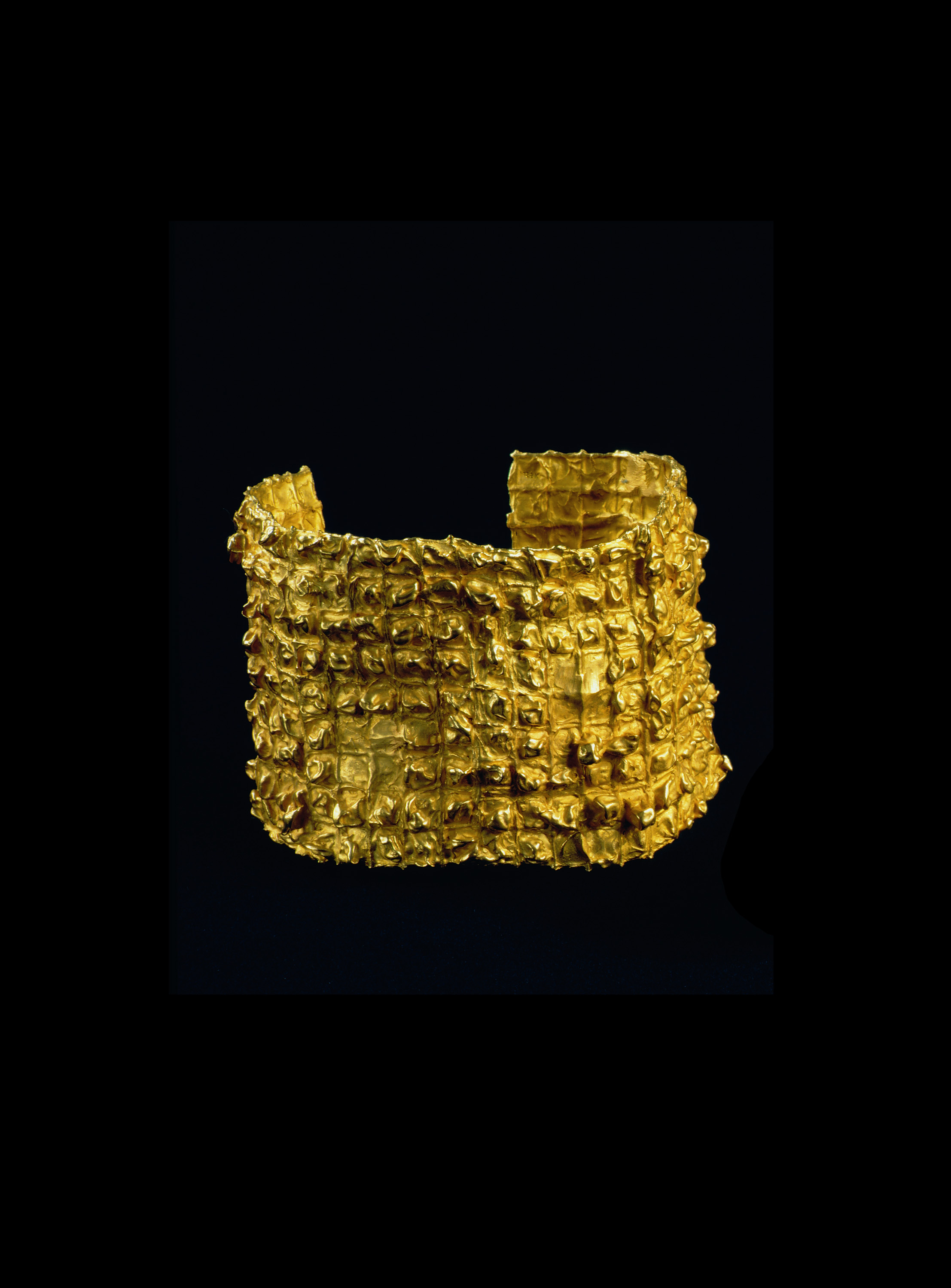
Between 1996 and 1998, Samaras produced a suite of sculptural jewelry, which he made by first modeling and painting chicken wire before casting it in solid 22-karat gold. These wearable artworks—some of which will be included in the exhibition—juxtapose the modest material of wire with the historical weight of gold, combining ornament and constraint in forms that press close to the body. Both visually opulent and physically heavy, they reflect Samaras’s long-time preoccupation with sensation, transformation, and the charged space between object and viewer.

Since his passing in March 2024, Samaras has been the subject of a long-term presentation at Dia Beacon, New York, which opened in September 2024.This exhibition, the last he collaborated on directly, features his Cubes and Trapezoids series—gifted to the institution by the artist in 2013 and presented here for the first time since their 1994 debut at Pace—alongside one of his signature mirrored rooms, Doorway (1966/2007).Earlier this year, 125 Newbury, Pace Founder and Chairman Arne Glimcher’s project space in New York City, presented a selection of never-before-seen pastels made by Samaras in the 1960s, shown in dialogue with a suite of figurative bronze sculptures he created in the early 1980s.
Throughout 2025, Pace is celebrating its 65th anniversary year with a series of exhibitions of work by artists who have been central to its program for decades. Presented around the world, these exhibitions are odes to some of the gallery’s longest-lasting relationships with artists including Jean Dubuffet, Sam Gilliam, Robert Indiana, Robert Irwin, Robert Mangold, Agnes Martin, Louise Nevelson, Kenneth Noland, Claes Oldenburg, Joel Shapiro, Antoni Tàpies, and James Turrell. Over the course of their careers, these figures, with Pace’s support, charted new courses in the history of art. Eluding historical categorization, Lucas Samaras’s (b. 1936, Kastoria, Macedonia, Greece; d. 2024, New York) oeuvre is united through its consistent focus on the body and psyche, often emphasizing autobiography. The themes of self-depiction, self-investigation, and identity were a driving force behind his practice, which, at its onset in the early 1960s, advanced the Surrealist idiom while proposing a radical departure from the presiding themes of Abstract Expressionism and Pop art.
Samaras emigrated with his family from Greece to the United States in 1948 and attended Rutgers University, New Jersey studying under Allan Kaprow and George Segal, and then at Columbia University, New York, where he studied art history under Meyer Schapiro. During this time, he initiated painting self-portraits and gravitated toward the use of pastels, which enabled him to work quickly, exploring figurative and geometrical forms in rich colors and with luxuriant texture, characteristics that would reoccur throughout his practice. He soon shifted toward objects, producing assemblage reliefs and boxes comprised of elements culled from his immediate surroundings and five-and-dime stores—cutlery, nails, mirrors, brightly colored yarn, and feathers—affixed with liquid aluminum or plaster. Gesturing toward a larger investigation of (self) reflection in his work found in his early mirror rooms, self-portraiture, and more recent use of digital mirror-imaging, Samaras’s oeuvre acts as an extension of his body while underscoring the transformative possibilities of the everyday—a true blurring of art and life.
In 1969, Samaras began to expand upon his use of photography, experimenting with a Polaroid 360 camera, which appealed to his sense of immediacy. His innovation further materialized with his use of the Polaroid SX-70 in 1973 in a melding of self-portraiture and abstraction, created by manipulating the wet-dye emulsions with a stylus or fingertip before the chemicals set. This process progressed with digital art in 1996 when he obtained his first computer and began to experiment with printed texts on typewriter paper. By 2002, he had acquired a digital camera, and the use of Photoshop became an integral component of his practice. These technologies gave way to Photofictions (2003), a series characterized by distorted self-portraits and psychedelic compositions.
Pace is a leading international art gallery representing some of the most influential artists and estates of the 20th and 21st centuries, founded by Arne Glimcher in 1960. Holding decades-long relationships with Alexander Calder, Jean Dubuffet, Agnes Martin, Louise Nevelson, and Mark Rothko, Pace has a unique history that can be traced to its early support of artists central to the Abstract Expressionist and Light and Space movements. Now in its seventh decade, the gallery continues to nurture its longstanding relationships with its legacy artists and estates while also making an investment in the careers of contemporary artists, including Torkwase Dyson, Loie Hollowell, Robert Nava, Adam Pendleton, and Marina Perez Simão.
Under the current leadership of CEO Marc Glimcher and President Samanthe Rubell, Pace has established itself as a collaborative force in the art world, partnering with other galleries and nonprofit organizations around the world in recent years. The gallery advances its mission to support its artists and share their visionary work with audiences and collectors around the world through a robust global program anchored by its exhibitions of both 20th century and contemporary art and scholarly projects from its imprint Pace Publishing, which produces books introducing new voices to the art historical canon. This artist-first ethos also extends to public installations, philanthropic events, performances, and other interdisciplinary programming presented by Pace.
Today, Pace has nine locations worldwide, including two galleries in New York—its eight-story headquarters at 540 West 25th Street and an adjacent 8,000-square-foot exhibition space at 510 West 25th Street. The gallery’s history in the New York art world dates to 1963, when it opened its first space in the city on East 57th Street. A champion of Light and Space artists, Pace has also been active in California for some 60 years, opening its West Coast flagship in Los Angeles in 2022. It maintains European footholds in London and Geneva as well as Berlin, where it established an office in 2023 and a gallery space in 2025. Pace was one of the first international galleries to have a major presence in Asia, where it has been active since 2008, the year it first opened in Beijing’s vibrant 798 Art District. It now operates galleries in Hong Kong and Seoul and opened its first gallery in Japan in Tokyo’s Azabudai Hills development in 2024.
The Intermission is a contemporary exhibition program space based in Piraeus, the historic port of Athens, Greece, initiated by Artemis Baltoyanni in September 2019. Centered on collaboration, The Intermission invites artists to occupy the space with specific projects in partnership with their representing gallery, when there is one, and supports the realization of new productions. The Intermission does not represent artists but aims to cultivate dynamic collaborations. This model allows for free-spirited and unconventional programming that responds to the ever-changing needs of its community. The Intermission hosts exhibitions by international galleries, offering them a momentary pause—or intermission—from their regular programming, and presents critically acclaimed artists: emerging, established, and historical.
- Lucas Samaras, Master of the Uncanny, opens at The Intermission on September 25. Runs till December 20. The Intermission is on 37A Polidefkous Street, Piraeus 18545. For more info visit the gallery’s site here (tel: 210-413-1504). Open Wed-Sat, 12-8pm.

Art Scene Athens’ is written/run by artist/journalist Stella Sevastopoulos. Dedicated to presenting what is happening on the Greek art scene (but not only), and also to giving Greek artists (and artists based in Greece) an international voice on the internet. For more on Stella Sevastopoulos’s art, click here If you would like to be featured in Art Scene Athens, please send email (stelsevas@yahoo.com).
 art scene athens