THE ACROPOLIS MUSEUM and NEON Organization present the second part of the ‘Michael Rakowitz & Ancient Cultures trilogy’: Michael Rakowitz’s ‘Lamassu of Nineveh’ (2018), curated by Professor Nikolaos Chr.Stampolidis, Director General of the Acropolis Museum, and Elina Kountouri, Director of NEON. It is a sculptural installation in the outdoor garden of the Acropolis Museum, on its west wing overlooking Mitseon Street. The work is a major sculptural extension of Michael Rakowitz’s ongoing series ‘The Invisible Enemy Should Not Exist’ (2006-ongoing). This sculptural installation will remain in the outdoor garden of the west wing of the Acropolis Museum till October 31, 2026. The first part of Rakowitz’s exhibition at the Acroplis Museum, entitled ‘Allspice’, will be on view till October 31, 2025 (for more on this exhibition you may visit the following article). The series consists of ‘reappearances’ of artefacts looted from the National Museum of Iraq in Baghdad following the U.S. invasion in 2003 or destroyed at other sites in its aftermath.
The Lamassu of Nineveh(2018) was originally commissioned for the Fourth Plinth in London’s Trafalgar Square. Constructed from empty cans of Iraqi date syrup, the sculpture reconstructs the protective Assyrian deity, a Lamassu: a colossal 4.3-metre winged bull with a human face that once stood at the entrance of the Nergal Gate in ancient Nineveh. The original monument, dating from around 700 BCE, was destroyed in 2015 by ISIS, along with many other artefacts in the Mosul Cultural Museum.
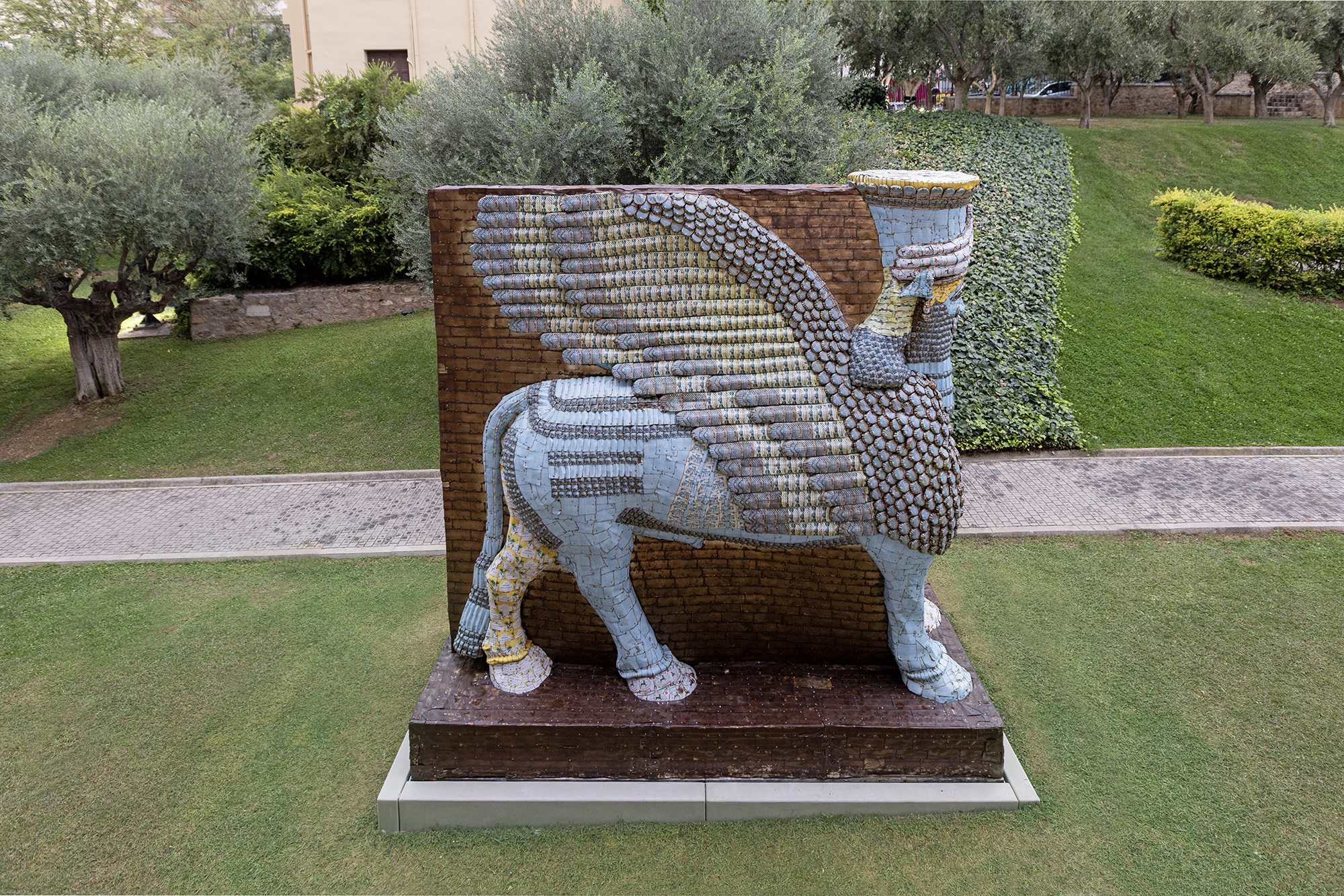
The Lamassu of Nineveh (2018 ) installation – situated in the surroundings of the Acropolis Museum – brings the sculpture into immediate dialogue with multiple layers of history and memory: the archaeological excavation visible beneath the Museum,the sacred landscape of the Acropolis above, the modern city around it, and the contemporary architectural space of the Museum itself.
Rakowitz uses empty cans of Iraqi date syrup for his Lamassu installation. These cans represent the once-renowned Iraqi industry that was decimated, as well as the human, economic, and ecological devastation wrought by the Iraq wars and their aftermath. Through objects, Rakowitz refers to the people who live alongside them and to their stories. The Lamassu ‘reappears’ and continues its role as guardian in the past, present, and future.
The reverse of the Lamassu features a carved cuneiform inscription that was invisible to viewers because it was cemented to the wall of the Nergal Gate. Here, in its removed and displaced state, the cuneiform is exposed. It translates as: ‘Sennacherib, king of the world, king of Assyria, had the (inner) and outer wall of Nineveh built anew and raised as high as mountain(s).’
The collaboration between the Hellenic Ministry of Culture, the Acropolis Museum, the Ephorate of Antiquities of Athens, and NEON is an in-depth conversation between contemporary works and ancient exhibits, highlighting eternal topics of cultural heritage, loss and restoration, survival, and the creation of culture. Greek antiquities and artefacts from the ancient civilizations of the southeastern Mediterranean and the Middle East converse with the multidimensional work of internationally acclaimed contemporary artist Michael Rakowitz, which lies at the heart of this project. The trilogy’s opening chapter, ‘Allspice| Michael Rakowitz & Ancient Cultures’, is hosted in the Acropolis Museum Temporary Exhibition Gallery until 31 October 2025.The trilogy will culminate with an exhibition at the Old Acropolis Museum.
Michael Rakowitz (b. 1973, Great Neck, New York, USA) is an Iraqi-American artist working at the intersection of problem-solving and trouble-making. Rakowitz explores the displacement of communities and cultural heritage caused by war and imperialism, activating everyday objects and employing unconventional approaches. He lives and works in Chicago, USA, and he is a Professor of Art Theory and Practice at Northwestern University, IL. His work has been exhibited worldwide, including at dOCUMENTA (13); P.S.1;MoMA; and Tate Modern, among others. He was awarded the 2018–2020 Fourth Plinth commission in London’s Trafalgar Square. From 2019 to 2020, a survey of Rakowitz’s work traveled from Whitechapel Gallery in London to Castello di Rivoli Museo d’Arte Contemporanea in Torino, and to the Jameel Arts Centre in Dubai. He was recently granted a commission on the topic of Archaeology and Migration Flows for the Municipality of The Hague.
ΝΕΟΝ is a nonprofit organization that works to bring contemporary culture closer to everyone. It is committed to broadening the appreciation, understanding, and creation of contemporary art in Greece and to the firm belief that this is a key tool for growth and development. NEON, founded in 2013 by collector and entrepreneur Dimitris Daskalopoulos, breaks with the convention that limits the contemporary art foundation of a collector to a single place. NEON’s space is the city. It acts on a multitude of initiatives, spaces, and civic and social contexts. It seeks to expose the ability contemporary art has to stimulate, inspire, and affect the individual and society at large. NEON constructively collaborates with cultural institutions and supports the programs of public and private institutions to enhance increased access and inventive interaction with contemporary art.
Second part: A Collaboration between the Acropolis Museum and NEON Lamassu of Nineveh (2018) | Michael Rakowitz & Ancient Cultures. Acropolis Museum, Sculptural Installation|Outdoor Garden of the Acropolis Museum, west wing, 6 October 2025–31 October 2026. Opening hours: Monday 9:00–17:00, Tuesday–Wednesday–Thursday 9:00–20:00, Friday 9:00–22:00, Saturday–Sunday 9:00-20:00. During winter months (November through March), on Tuesday–Wednesday-Thursday the Museum is open 9:00-17:00.
Free entrance Information: neon.org.gr&theacropolismuseum.gr
For more info you may visit the Acropolis Museum’s site here
 art scene athens