THE NATIONAL MUSEUM OF CONTEMPORARY ART (or EMΣT), added two more shows that launch the museum’s autumn programme: The Greek Month in London 1975, 50 Years On—Art at a Time of Political Change, and Sea Garden. These two distinct exhibitions together illuminate the intersections of history, landscape, and artistic innovation across time and place.

which was realised in 1975
The Greek Month in London 1975, 50 Years On—Art at a Time of Political Change reflects the museum’s mission to cultivate creative practices of memory that resist the prevailing culture of amnesia toward the past. By revisiting a pivotal moment in Greece’s post-dictatorship cultural history, the exhibition highlights how key artistic events have shaped the country’s contemporary identity and international presence.
In contrast, Sea Garden reflects EMΣT’s ongoing commitment to supporting emerging Greek curators and new curatorial voices. Winner of the museum’s Open Call for curatorial proposals, the exhibition invites viewers to consider how art reimagines our relationship with landscape, ecology, and belonging in the Mediterranean and beyond.
At once retrospective and prospective, the double opening marks EMΣT’s continuing effort to build a living archive of artistic and curatorial practices that have shaped, and continue to shape, the field of contemporary art in Greece and beyond.
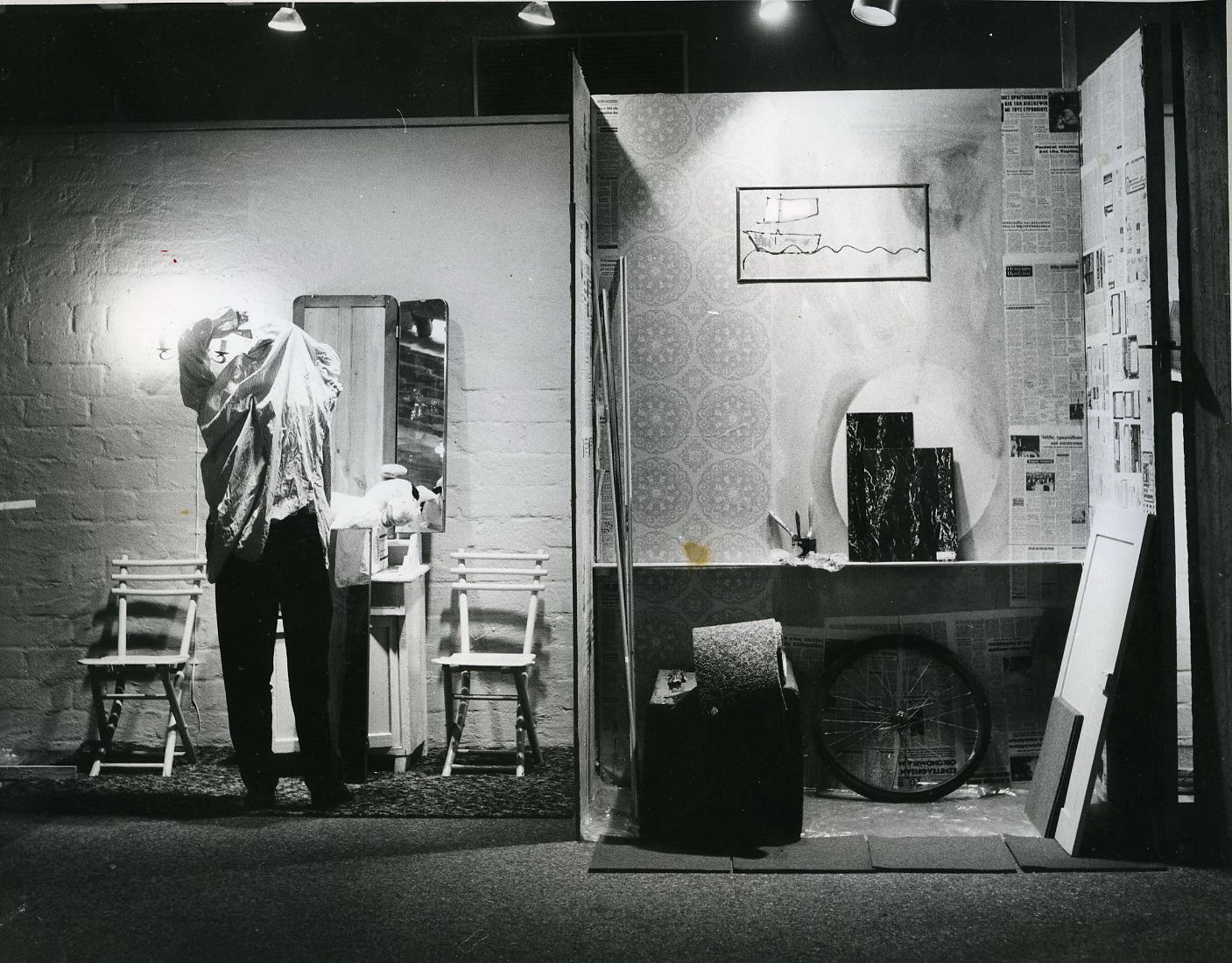
The Greek Month in London 1975, 50 Years On—Art at a Time of Political Change revisits the landmark cultural initiative “Greek Month,” presented in London in 1975, in the immediate aftermath of the military dictatorship. Curated by Polina Kosmadaki, the exhibition re-examines the visual arts programme organised by Christos M. Joachimides and Sir Norman Rosenthal, which sought to reintroduce Greek art to the international stage during a period of political transition and renewed democratic optimism. Central to that programme were two seminal exhibitions: Four Painters of 20th Century Greece, which presented an older generation of largely modernist artists, and Eight Artists, Eight Attitudes, Eight Greeks, which showcased a younger generation of contemporary artists defining a new avant-garde.
The exhibition at EMΣT focuses on the latter. It was important because it articulated a first collective image of a “Greek avant-garde,” framed by a newly restored democracy and the wish to redefine Greece’s cultural position within Europe. Half a century later, EMΣT returns to these questions, foregrounding the curatorial vision of Joachimides and Rosenthal as a political and artistic gesture of its time.
Through works by Stephen Antonakos, Vlassis Caniaris, Chryssa, Jannis Kounellis, Pavlos, Lucas Samaras, Takis, and Costas Tsoclis—from EMΣT’s own and other Greek collections—the exhibition unfolds as both an act of remembrance and a dialogue with the present. Archival materials, catalogues, correspondence, and rare documents are presented publicly for the first time, illuminating how the London exhibitions negotiated ideas of national identity, exile, and artistic autonomy in the aftermath of dictatorship.

1975, 50 Years On—Art at a Time of Political Change‘
Eight Artists, Eight Attitudes, Eight Greeks highlighted that the “Greek avant-garde” was never simply a stylistic category but a condition of historical awareness, a way of confronting the paradox between an inherited past and an uncertain present. By re-reading The Greek Month through contemporary eyes, EMΣT positions curatorial practice itself as an instrument of historical consciousness, capable of tracing the fragile links between art, politics, and the collective imaginary, whilst revisiting its contested reception at the time.
In parallel, Sea Garden, curated by Danai Giannoglou and Kyveli Mavrokordopoulou, offers a different but equally resonant meditation on terrain and transformation. Selected as the winning proposal of EMΣT’s second open call for emerging Greek curators, the exhibition unfolds as a fluid, intergenerational constellation of artists—Claude Cahun, Dora Economou, Catriona Gallagher, Ana Mendieta, Margaret Raspé, and Athena Tacha—whose works articulate a poetic ecology of bodies and landscapes.
Taking its title from Sea Garden (1916), the poetry collection by American poet H.D., the exhibition begins from the practice of Athena Tacha, whose sculptural investigations of natural form, movement, and bodily gesture provide both anchor and departure point. From there, Sea Garden drifts across temporal and geographic currents, tracing the shifting edge where land meets sea, dryness meets wetness, and material meets metaphor.

Each artist contributes a distinct language of embodiment: Cahun’s metamorphic self-portraits, Mendieta’s ephemeral earth-body actions, Raspé’s ecological film works made on the Greek island of Karpathos, Gallagher’s ongoing study of the dry garden of Sparoza in Attica, and Economou’s sculptural mutations that fuse host and parasite, organism and object. Together they reveal a landscape that is not passive ground but a living participant in human and non-human histories.
The exhibition engages landscape as a site of friction, ecological, social, and gendered, foregrounding how its transformations reflect global crises while also holding potential for care and regeneration. By evoking the notion of a “sea garden,” curators Giannoglou and Mavrokordopoulou propose the border not as a line of separation but as a porous space of becoming.
Accompanied by the public programme, I even lost my shadow, with contributions by Stefanos Levidis, Danae Io, Margaret Raspé, Catriona Gallagher, and Fredj Moussa, the project extends beyond the gallery into a field of research, performance, and discussion.

Presented together, The Greek Month in London 1975, 50 Years On—Art at a Time of Political Change and Sea Garden articulate EMΣT’s evolving commitment to the politics of memory and the poetics of fragility. One turns to the archives of the recent past to re-evaluate the trajectories of Greek modernity; the other turns to the fluidity of the natural world to sense the urgencies of the present. Both affirm the museum as a site where history and landscape, body and nation, can be revisited not as fixed categories but as open questions.

WHAT’S MORE:
Already running at the museum is the exhibition Why Look at Animals? A Case for the Rights of Non-Human Lives, which has the museum taken over by a whole host of animals and animal sounds, creating awareness about the way they have been treated and abused by humans.
Rather than focusing on representations of animals in art history, Why Look at Animals? shifts the frame toward animal rights, sentience and ecological entanglement, spotlighting the systemic injustices inflicted on non-human life. Extending across all seven floors of the museum, the programme draws inspiration from John Berger’s seminal 1980 essay and offers an ethical and philosophical exploration of humanity’s complex, often contradictory relationship with animals. It features work by more than 60 international artists addressing themes such as speciesism, intelligence and communication, the climate crisis, and the moral implications of modern human-animal dynamics.
Sammy Baloji: A Case of History, Shadows of Progress, is also running at EMΣT, plus an exhibition with works by the Greek sculptor Thodoros, in situ works by Emma Talbot and Kasper Bosmans, the Collection Exhibition, and an exhibition with the works from the D.Daskalopoulos Collection. Haddassah Emerich’s colourful ‘Epicurean Eden’ can also be viewed.
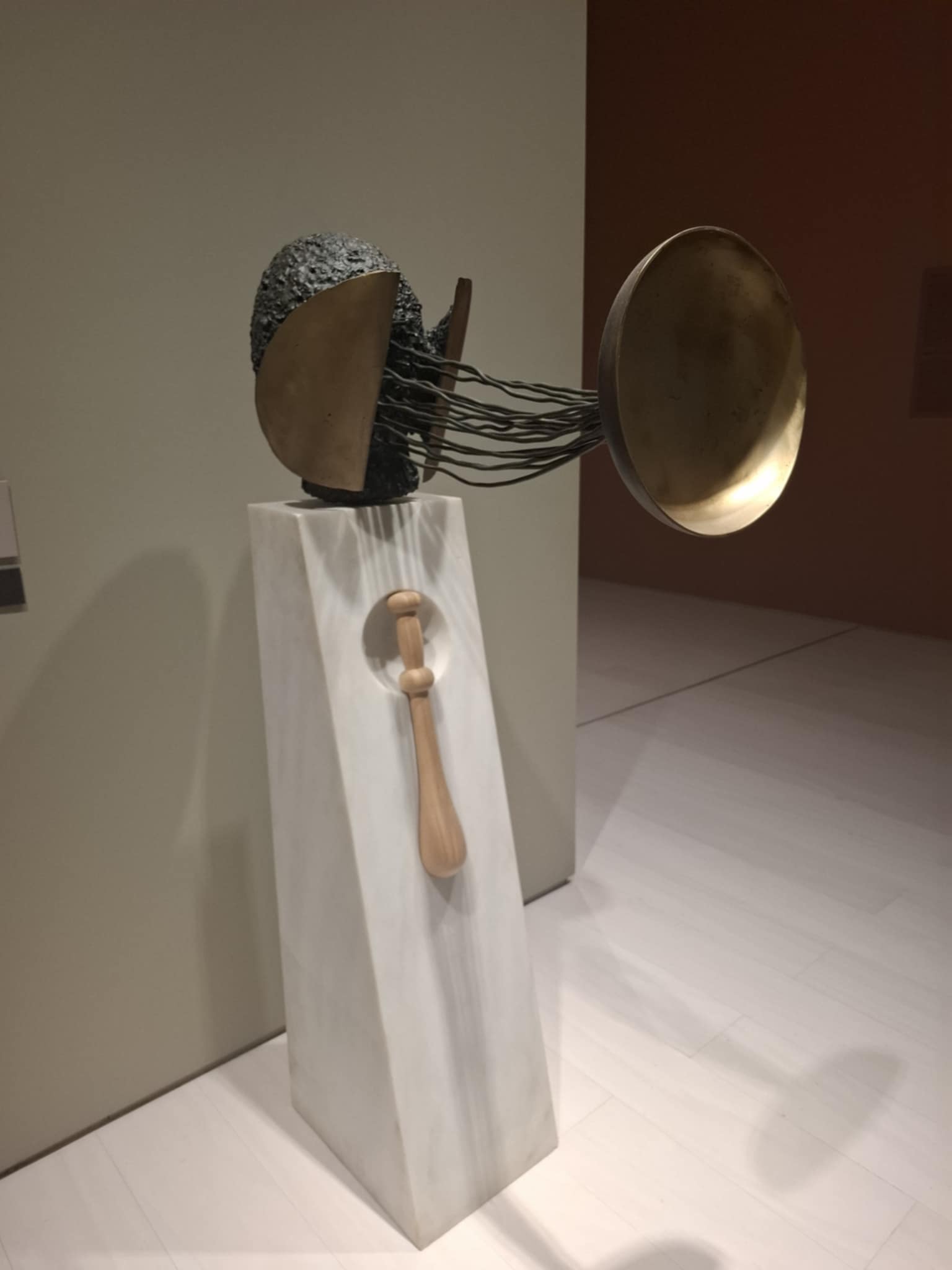
AWARD-WINNING EXHIBITION
The National Museum of Contemporary Art, Athens (EMΣΤ) proudly announced recently that its Artistic Director, Katerina Gregos, has been awarded the 2025 Nancy Regan Arts Prize by the Culture & Animals Foundation (CAF), founded in the United States in 1985 by acclaimed philosopher Tom Regan (1938–2017) and his wife, Nancy (1938–2021).
This international distinction is awarded annually to honour outstanding achievement in the arts and, this year, recognises Gregos for her groundbreaking curatorial work. The award specifically acknowledges the “trailblazing” exhibition, Why Look at Animals? A Case for the Rights of Non-Human Lives, which is currently on view at EMΣΤ until April 2026.
For more info on tickets/visiting times etc, visit the museum’s site here
Art Scene Athens’ is written/run by artist/journalist Stella Sevastopoulos. Dedicated to presenting what is happening in the Greek art scene (but not only), and also to giving Greek artists (and artists based in Greece) an international voice on the internet. For more on Stella Sevastopoulos’s art, click here If you would like to be featured in Art Scene Athens, please send email (stelsevas@yahoo.com).
 art scene athens