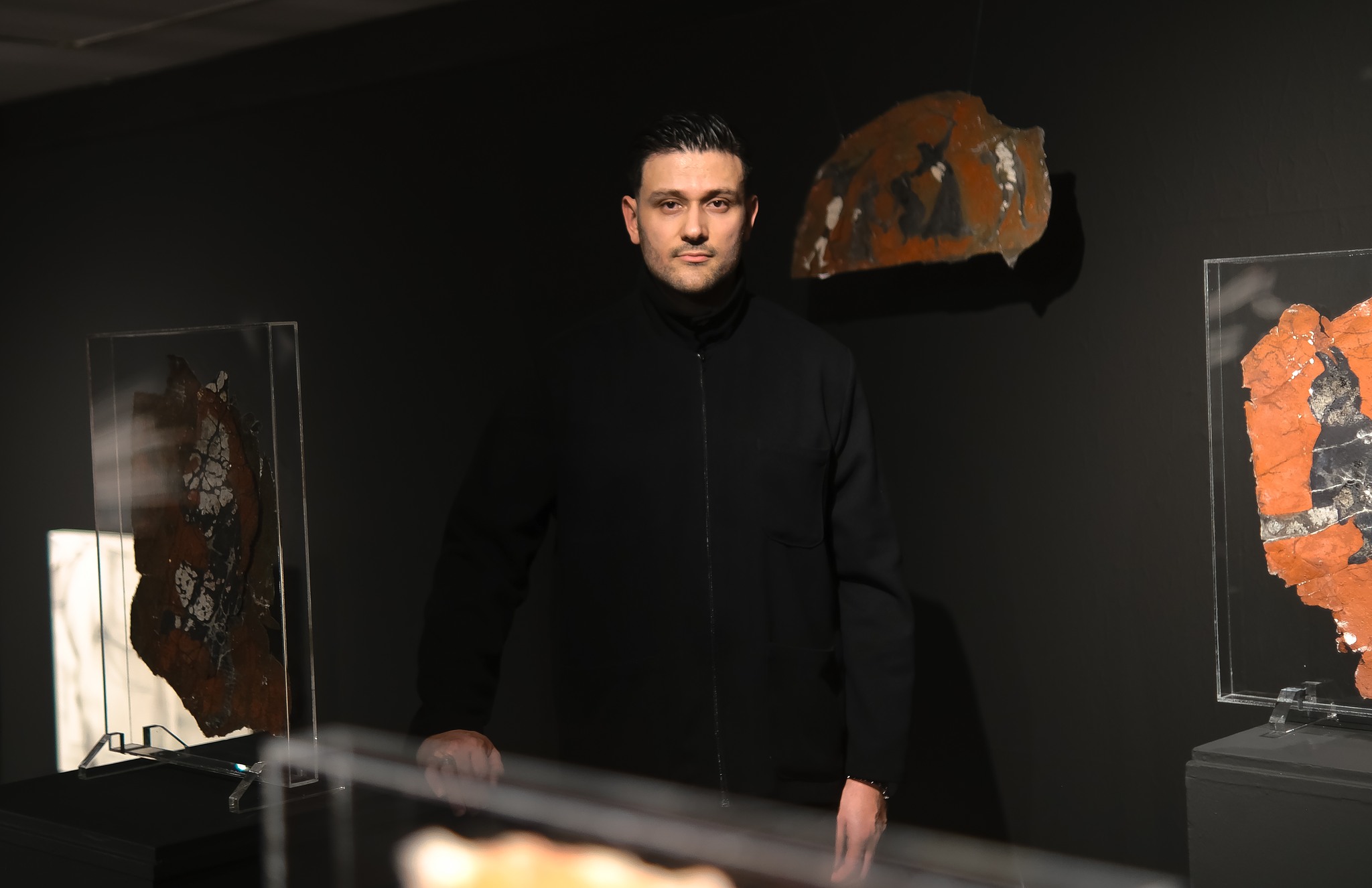
NIKOS KANOGLOU’S first solo show, currently running at the Hellenic-American Union’s Kennedy Gallery, presents three units of work, each different in terms of methodology and materials used, yet connected in their exploration of history and the experiential notion of time. Earthy reds prevail in a series where scenarios made out of cut-out figures and forms, are lit in such a way as to cast shadows on the black walls of the gallery. The earthy colours continue in a unit where frescoes and fragments of walls have been presented in plexiglass boxes. And the greys of graphite prevail in another series of immaculately drawn works on canvas or paper. “The Absence of the Present” is the title of this exhibition which invites the viewer to question the course of history, its chosen ‘narratives’ and to question how history is created. The exhibition runs till February 28.
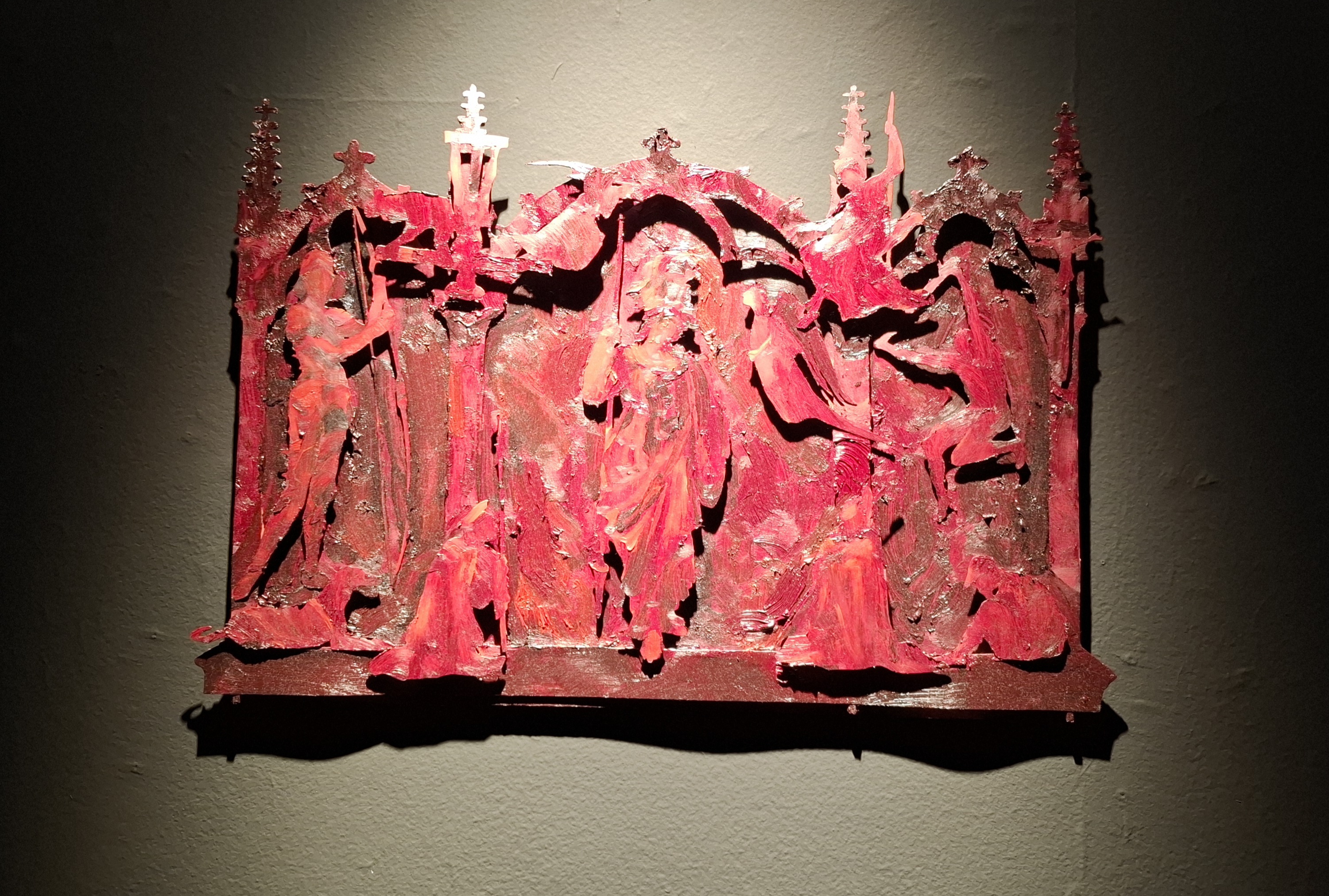
Nikos Kanoglou’s cut-out figures have been made from boiled leather, to which gold and then paint is applied. This method, known as cuir bouilli, was popular in the medieval times, and was used especially between the 12th and 14th centuries for creating armor. But in the case of Kanoglou, it has now been applied to art. Via this process, Kanoglou has created whole scenarios, the largest one of which tells a narrative about the history of mankind. But it isn’t the usual story. Various gods and goddesses, heroes, cultures and myths, religions, leaders and politicians may be referred to, but the aim of this work is to question who and what has played a role in history, and who, or what, hasn’t been documented. The figures that are lit, are the main protagonists, but in the darkness, there are other figures and scenarios also at play. From Salome to Athena, the image of Christ on the cross, to the arm of Lenin, important chapters in the course of human history are presented in this work, which could also be a stage scene, with influences even from the Karaghiozi tradition of cut-out puppets. As Shakespeare had said, all the world’s a stage, and we the players on it. But, who gets the lead role and who stays behind the scenes, often playing an equally important role? That is the question.
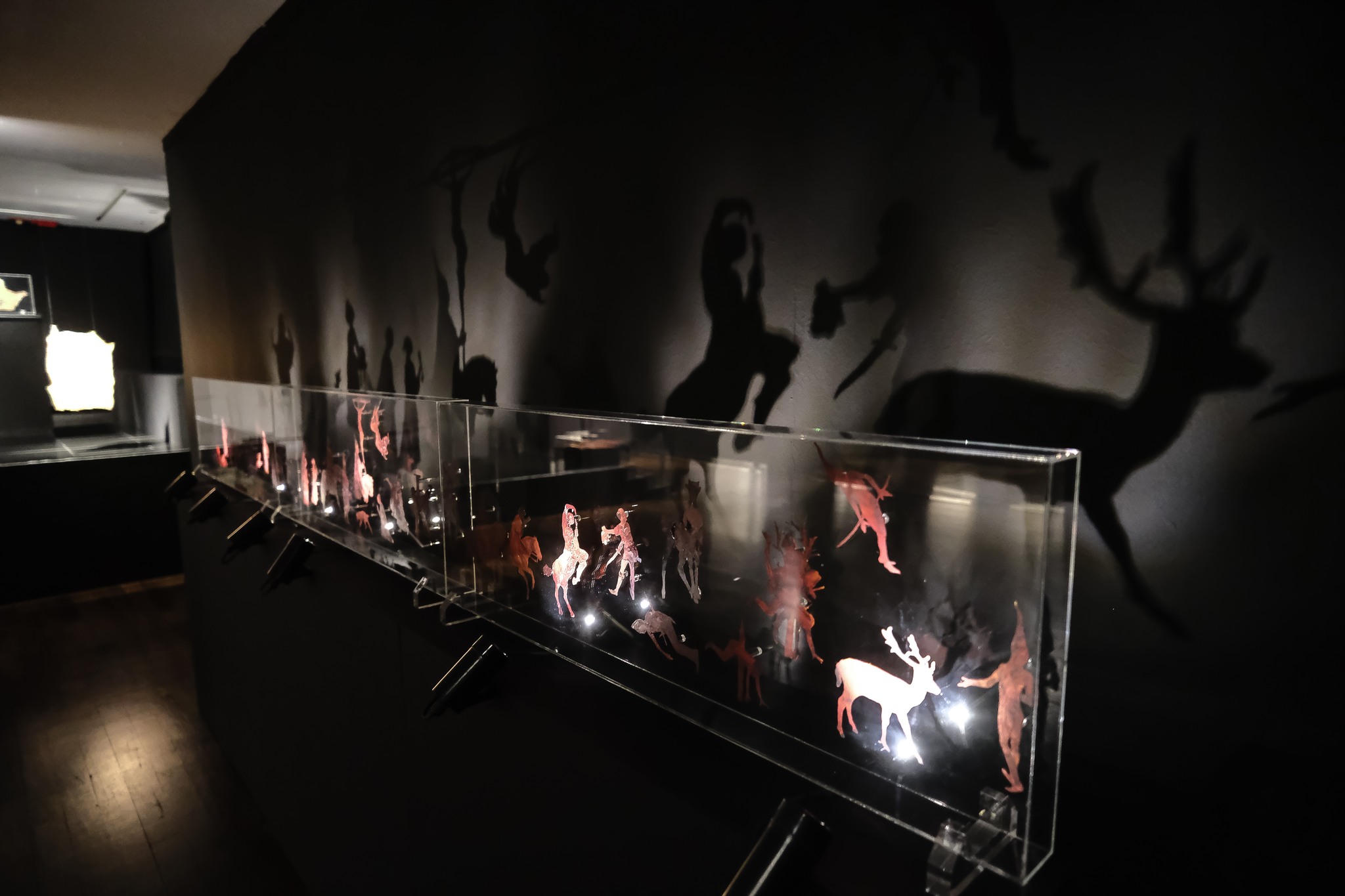
Kanoglou explains more about his artistic mis en scene, and its narrative that relates to the course of human history:
“Many have died who were not written about in the history books, invisible heroes. The crucified figure in the centre, is not Jesus, it is a part of history, because the populace has been formed from Orthodox Christianity, and protestant ethics. This is something to think about, how Christianity has influenced our way of thought. The historian Le Goff has said that in the medieval times, it was more important what you had, rather than who you are. It seems that we are returning to this dark age. If you stole 10 eggs, the punishment was death. If you killed someone, the punishment was 10 lashings. We forget. We are a generation who hasn’t lived through the 2nd World War. We have no idea. It seems that history repeats itself. New dictatorships seem to be emerging. This isn’t a didactic work. Today, we seem to perceive what is happening but don’t have the strength to do something about it.”
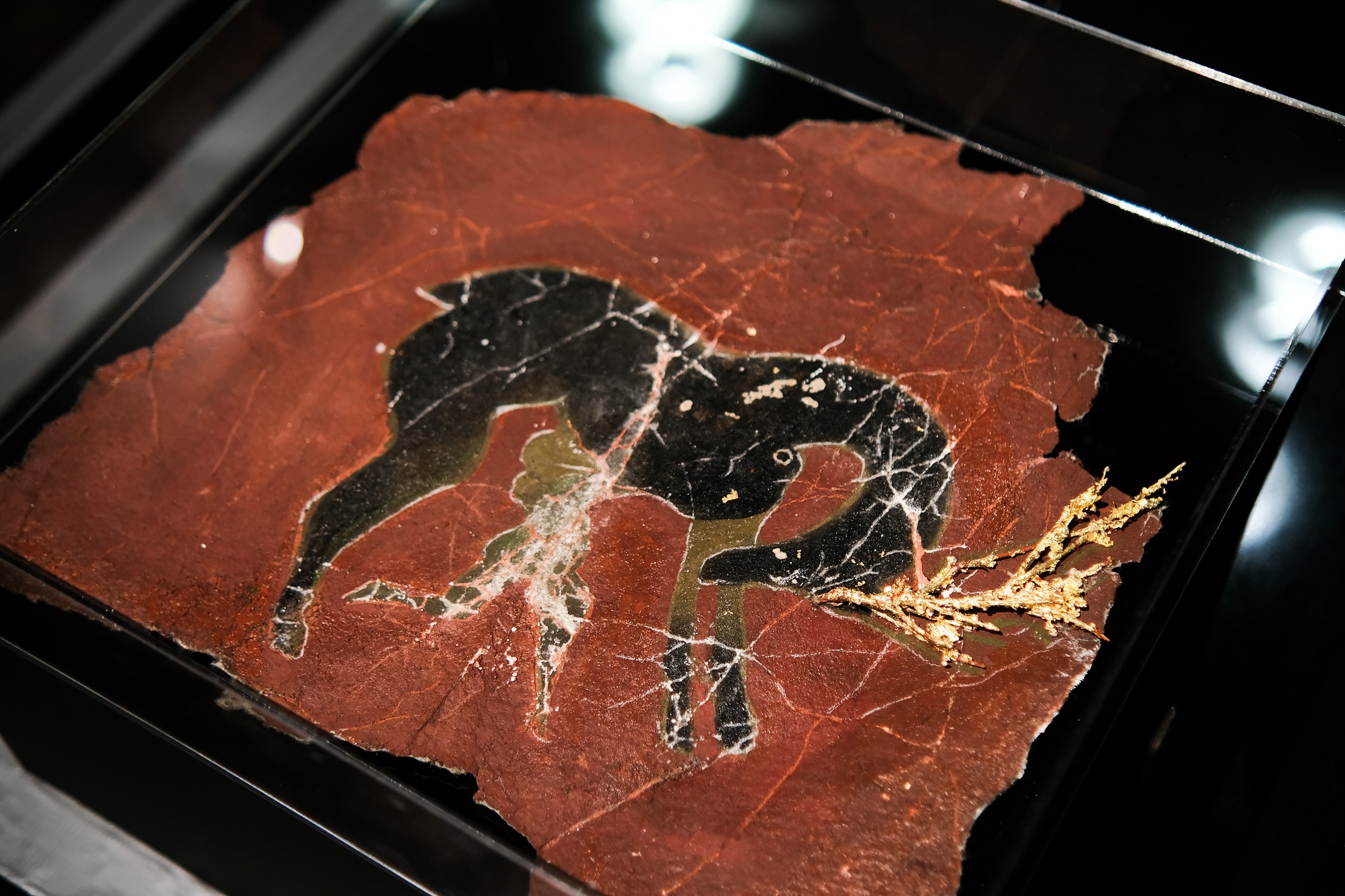
In another section of the exhibition, wall frescoes and paintings are presented, which Kanoglou found in an old Arcadian village lost in time. He removed them from the walls, and gave them a new lease of life via his artistic creativity. But the largest part of the exhibition focuses on Kanoglou’s drawings, of ancient Greek sculptures and figures, but also freer drawings of bees. Kanoglou draws on the back-side of gessoed canvas, because he is interested in the weave and the texture there.
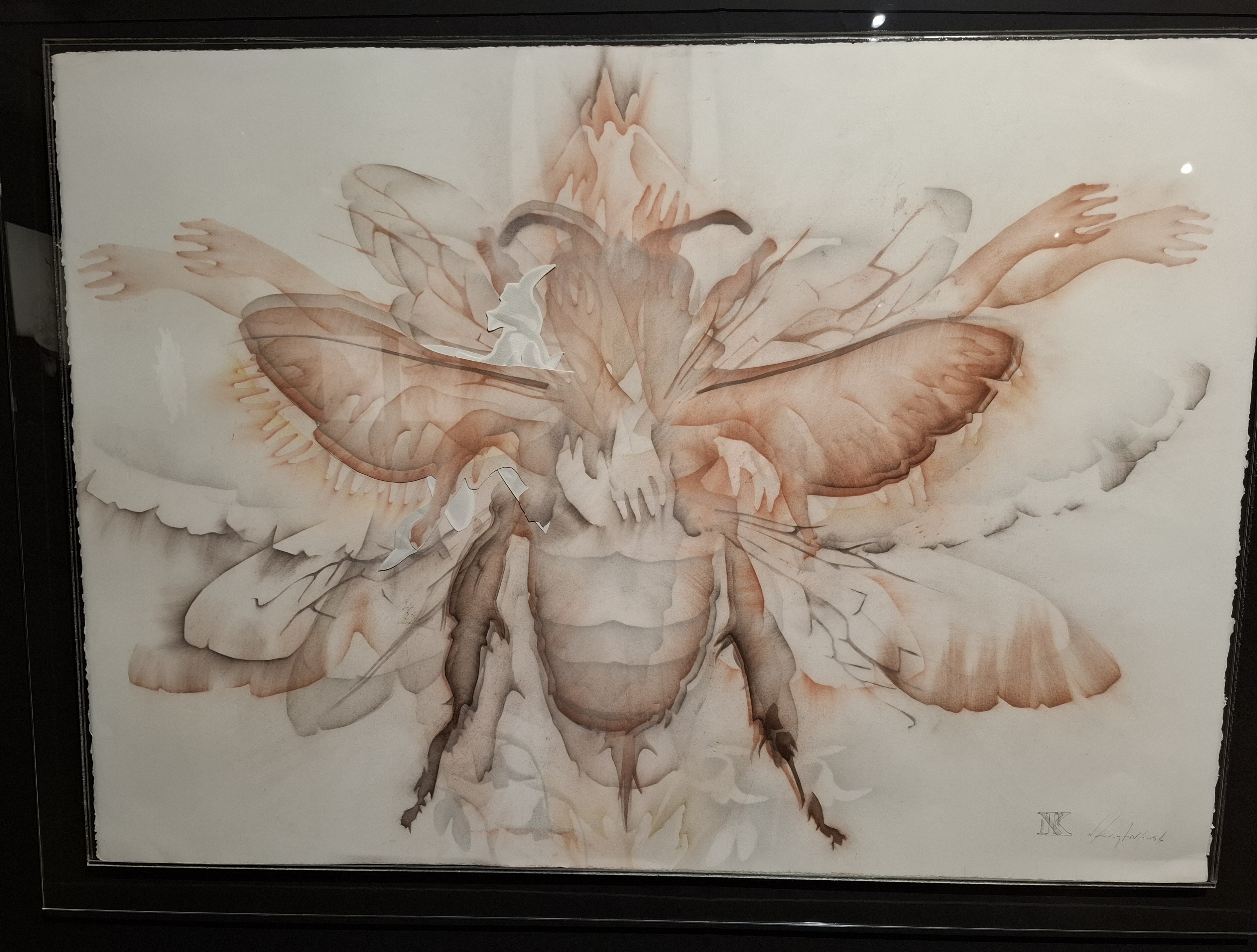
“The Absence of the Present,” is curated by the artistic collective Xylinos Ippéas (Wooden Horse), and unfolds around a body of work in which human, animal, and mythological figures reappear as traces of memory and experience. With drawing and monochromy at its core, and through successive layers of materials such as graphite, Chinese ink, mineral powders, inert matter, and collage. Form disperses and is reactivated, while time is experienced as pause and silent duration.
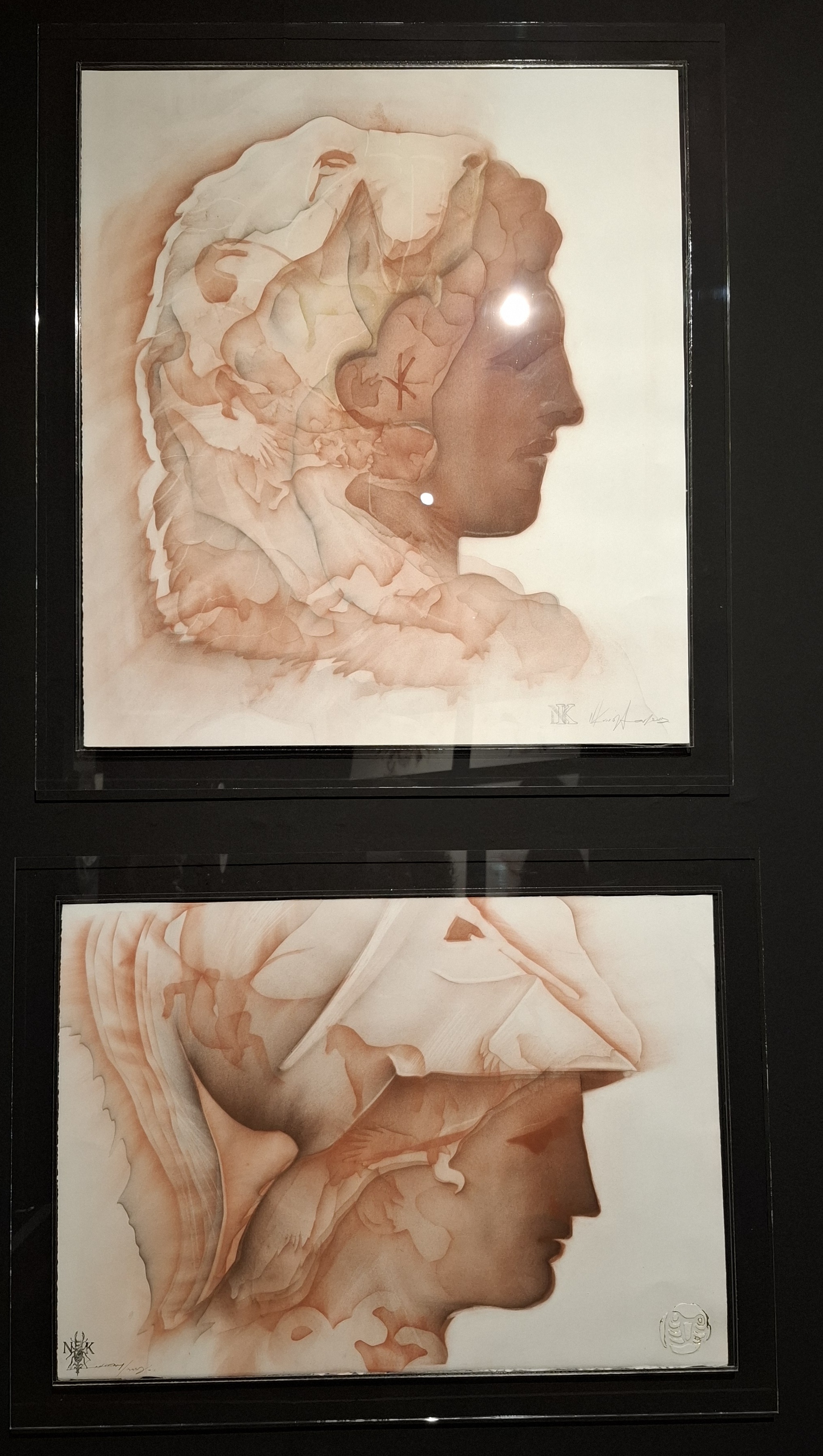
The exhibition offers a different viewing experience—one in which the gaze is not invited to conquer the image, but to remain within it. Here, it is not the solid certainty of form that is recorded, but the trace of the image: an imprint that persists after certainty has withdrawn.
Nikos Kanoglou is a visual artist with studies in interior design and architecture. He is the founding member of the artistic collective Xylinos Ippéas. He works primarily in painting and drawing, creating large-scale works. His artistic practice focuses on the fragility of materials and on the relationship between form, memory, and time, employing media such as paper, natural canvas, and distinctive surfaces. He has participated in major group exhibitions in museums and municipal galleries in Greece, as well as in private exhibition spaces, and his works are held in public and private collections in Greece and abroad.
“The Absence of the Present”, solo exhibition by Nikos Kanoglou at the Hellenic-American Union, runs till February 28.
Opening Hours
Monday–Friday: 12:00–20:00
Saturday: 10:00–14:00
Admission
Free entry
Location
Kennedy Gallery
22 Massalias Street, Athens
Art Scene Athens’ is written/run by artist/journalist Stella Sevastopoulos. Dedicated to presenting what is happening in the Greek art scene (but not only), and also to giving Greek artists (and artists based in Greece) an international voice on the internet. For more on Stella Sevastopoulos’s art, click here If you would like to be featured in Art Scene Athens, please send email (stelsevas@yahoo.com).
 art scene athens