THE BASIL & ELISE GOULANDRIS FOUNDATION has collaborated with leading European museums and important private collectors in order to bring, for the first time in Greece, a comprehensive tribute to Neo-Impressionism, focusing on the Mediterranean region. The exhibition is under the auspices of the French Ministry of Culture. The exhibition “Neo-Impressionism in the colors of the Mediterranean” runs till April 7, and comes with an interesting parallel programme for all ages.
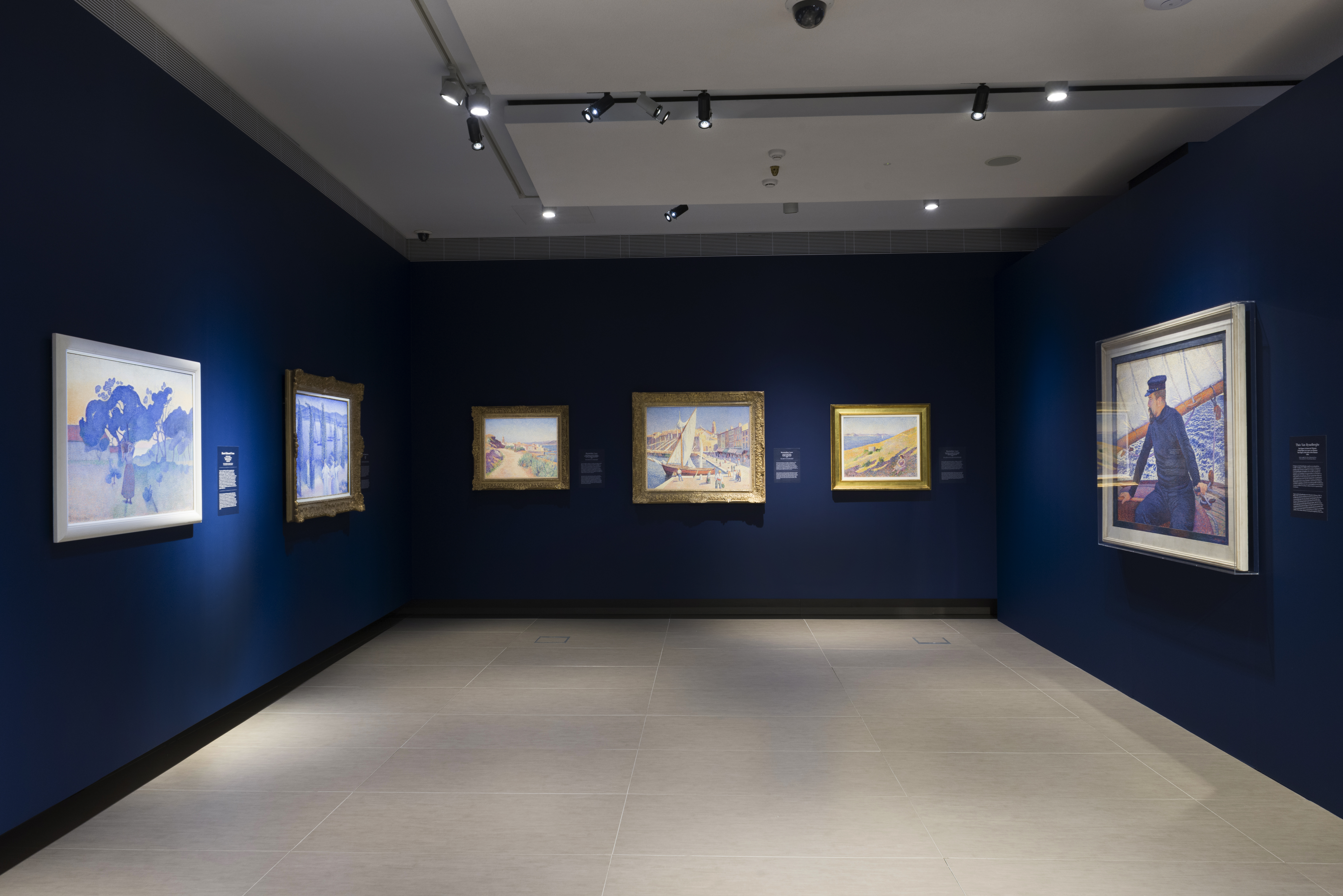
The term “neo-impressionism” was originally proposed by the French art critic Félix Fénéon, who wanted to make the connection with the impressionism movement while emphasizing, with the prefix “neo-“, the divisions between the two trends. The term prevailed over the term “division” (or “divisionism”) defended by Signac, as well as over the term “pointillism”, which gradually began to appear in newspapers but was deemed inappropriate by the artists of the movement as it exclusively described the process (the specific term is however widely used to this day).
The exhibition “Neo-Impressionism in the colors of the Mediterranean” is held in collaboration with important museums and institutions in Europe such as, among others, Musée d’Orsay, National Gallery of London, Center Pompidou, Musée des Beaux-Arts de Besançon, Musée de l’ Annonciade, Musée de Grenoble, Musée national d’archéologie, d’histoire et d’art – Luxembourg and Musée des Arts Décoratifs as well as European private collectors. The exhibition presents works by Paul Signac, Henri-Edmond Cross, Maximilien Luce, Théo van Rysselberghe, Henri Matisse, Henri Manguin and Louis Valtat, most of which are coming to Greece for the first time.
The curators of the exhibition are Marina Ferretti Bocquillon, Honorary Scientific Director of the Giverny Museum of Impressionism (Musée des impressionnismes Giverny) and Maria-Koutsomalli-Moreau, Collection Manager of the B&E Goulandris Foundation.
The exhibition is accompanied by a detailed catalog in Greek and English, with texts by the two curators as well as by the Director of the Signac Archive Charlotte Hellman Cachin.
The history of Neo-Impressionism
On March 29, 1891, Georges Seurat died suddenly, at the age of 31. After the loss of the founder of Neo-Impressionism, the other members of the group, namely Paul Signac, Henri-Edmond Cross, Maximilien Luce and Théo Van Rysselberghe, feel orphaned. Many art critics and fellow painters, including Camille Pissarro, predict the imminent end of this artistic movement, which they interpret, wrongly, as an ephemeral and unruly offshoot of Impressionism. In fact, Seurat’s death only seals the close of the first chapter of Neo-Impressionism. A second chapter will open very soon, far from Paris, on the shores of the Mediterranean. And Signac, now head of the group, leads it towards new horizons, both geographical and artistic.

The present exhibition is dedicated to Neo-Impressionism as it flourished on the shores of the Mediterranean. It traces the evolution of Signac, Cross, Luce and Van Rysselberghe towards a freer and bolder painting. The palette of these artists, lovers of pure colors, becomes ever more vigorous and vivid, depicting in the most eloquent way the words of writers who had wandered before them on that still impregnable coastline: Guy de Maupassant, Stendhal, Théodore de Banville …The Mediterranean climate, originally preferred by people with health problems, attracts more and more art lovers who are fascinated by a painting now deeply rooted in the senses and subjectivity.
Passing in front of the paintings, we discover Lavandou, Collioure, Cassis, Saint-Tropez, Antibes, Marseilles, Cavalier, Agai, Antior, then Venice and Constantinople. This journey gives us the opportunity to follow the visual path of each artist. We thus see Signac and Cross staying true to the neo-impressionist technique – or “divisionism” – until the end of their lives, unlike Luce and Van Rysselberghe, who gradually move away from it. New artists such as Henri Matisse, Henri Manguin and Louis Valtat would experiment with this technique with more or less thoroughness, but also with an independence of spirit that heralded revolutions to come.

Renaissance on the shores of the Mediterranean
The first to discover the Mediterranean coast is Cross, in 1883. Looking for some isolated place that has escaped the encroachment of industry and tourism, in 1891 he settles in Cabaçon, near Lavandou, and then definitively in Saint-Clair. In 1892 he is followed by Signac, who dreams of living away from Paris for part of the year and chooses Saint-Tropez, a small fishing port at that time, not far from Saint-Clair.
The works of that first Mediterranean period reveal a group of artists ready to continue the Neo-Impressionist adventure, despite difficulties and criticism. Each in their own way, they gradually move away from Seurat’s teaching and allow an increasingly subjective painting to emerge on the canvas. Thus, they allow the divisionist technique to shed its predominantly rigid side and unfold with unprecedented vigor.
Freeing the color
In contact with the Mediterranean sun, sometimes beneficial or merciless, Signac, Van Rysselberghe, Cross and Luce deepen their visual pursuits, orienting the neo-impressionist movement to a painting with more colors and more contrasts. The dot gets bigger, and evolves into a small dash more freely. Cross and Luce did not hesitate to transfer this development to the human figure, thus creating allegorical scenes that soon fascinated many young artists, including Matisse.
The discovery of the shores of the Mediterranean continues with the same enthusiasm: Toulon, Marseilles, Antibes, Venice, Constantinople… Signac gives us the most characteristic testimonies of the constantly renewed attraction to the south, which is becoming the ideal place for future innovations. But that same period is also marked by the progressive distancing of Luce and van Rysselberghe from the divisionist technique.

The attraction to watercolor
It was Pissarro who encouraged Signac to take up watercolor, as early as 1888. However, he would have to wait until 1892 and his arrival in Saint-Tropez to devote himself to watercolors with real zeal and enthusiasm. Signac now emerges as a leading watercolorist, able to capture with rare talent the beauties of the moment, to which the Impressionists attached great importance. Very soon his watercolors, which he insisted on exhibiting alongside his paintings, attracted painting enthusiasts. In addition, the watercolor technique allows him to travel with lighter equipment and multiply studies. Returning to La Hune, his refuge in Saint-Tropez from 1895 onwards, he creates the paintings inspired by those studies.
Cross will discover the allures of watercolor in the late 19th and early 20th centuries. He uses brushmarks very different from the ones he applies to his paintings, thus expressing a new freedom, free from the technical constraints of divisionism.

Dialogue with the fauvists
In 1905 the critic Louis Vauxcelles wrote of the French south: “They all flocked there, like a flock of migratory birds. […] a small brave colony of painters who painted and conversed in that enchanting place”. Mainly thanks to their elders Signac, Van Rysselberghe, Cross and Luce, Matisse, Manguin and Valtat will in turn discover the Mediterranean. Before Collioure – which Matisse and André Derain would turn into the cradle of modernism – Saint-Tropez, Cavalier, Saint-Clair and Agaille became the experimental fields of the future Fauvists. In dealing with them, the Neo-Impressionists generously offered their maturity as established artists, without necessarily following the bold approaches of their younger counterparts. After all, Signac will address them with words revealing the essential influence of Neo-Impressionism on modern art: “This triumphant colorist has only to appear: we have his palette ready for him.”
Exhibition information:
Curators: Marina Ferretti Bocquillon, Honorary Scientific Director of the Musée des impressionnismes Giverny
Maria Koutsomalli-Moreau, Collection Manager of the B&E Goulandris Foundation
Duration: January 10 – April 7, 2024
Opening hours: Monday, Wednesday, Thursday, Saturday & Sunday 10.00-18.00, Friday 10.00-20.00
Closed on Tuesday.
Vassilis & Elizas Goulandris Foundation is on 13 Eratosthenous St, Athens 11635
T: 210 725 2895; visit@goulandris.gr | goulandris.gr

‘Art Scene Athens’ is written/run by artist/journalist Stella Sevastopoulos. Dedicated to presenting what is happening on the Greek art scene (but not only), and also to giving Greek artists an international voice on the internet. For more on Stella Sevastopoulos’s art, click here If you would like to be featured in Art Scene Athens, please send email (stelsevas@yahoo.com).


Nice accumulation of art facts Stella. And wonderful to come across ‘Collioure’ from where I lived not far away during my South of France life.
LikeLike