OKUPA, the urban hub with its eye on contemporary creativity, is getting ready to host a new exhibition entitled “Mythic Syntax”, by Greek artist Dimitris Ntokos. The exhibition opens 6-9pm, on April 29, and invites viewers to experience a new body of paintings and sculptural works that expand the artist’s visual language into complex symbolic systems where myth, history, and material converge. Powered by Domus Art Gallery, this event dynamically explores the shifting boundaries between art and language, past and present.
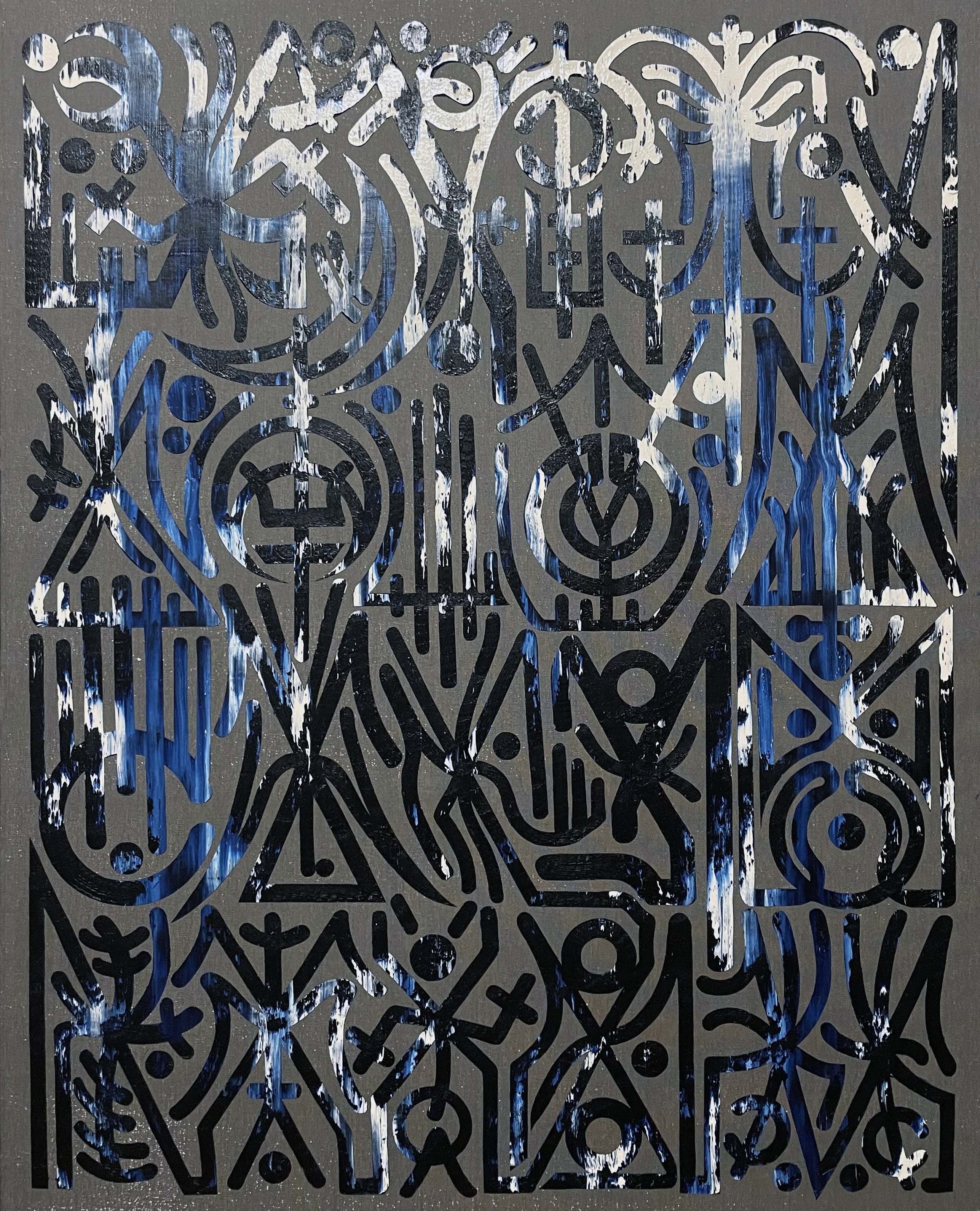
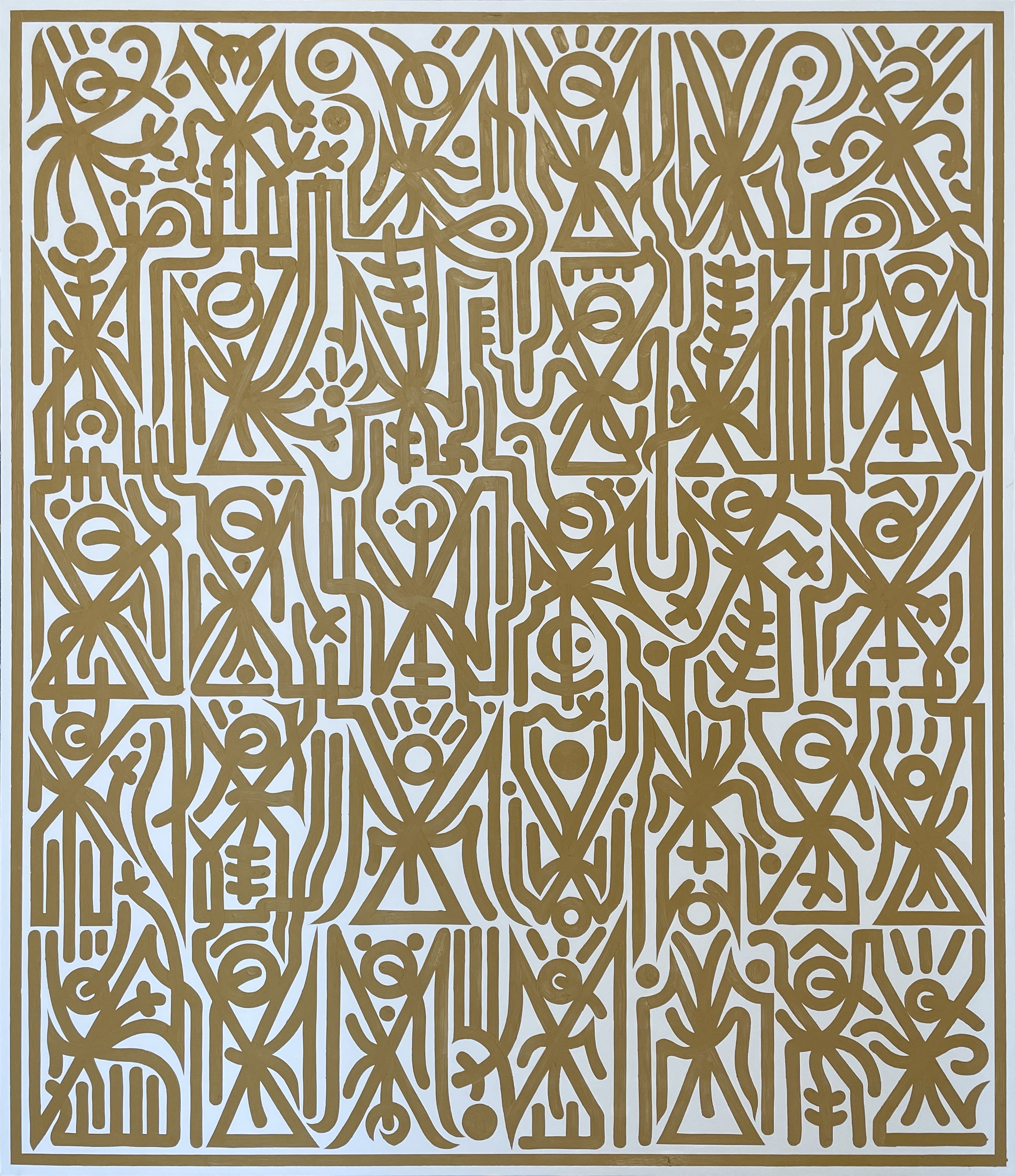
In “Mythic Syntax”, visitors will get a chance to see some of Ntokos’s paintings that incorporate his own unique hieroglyphics, but also his new ceramic works. It is as if Ntokos’s characteristic hieroglyphs have now jumped from the picture-plane to the pot: ceramic vases, set in the environ of archaeological findings, have been elaborately painted upon by the artist. While Ntokos’s hieroglyphic paintings speak of the fusion of ancient script with modern graffiti, his ceramic creations also pay homage to this artist’s interest in antiquity and cultural heritage.
Between the written word and the visual world
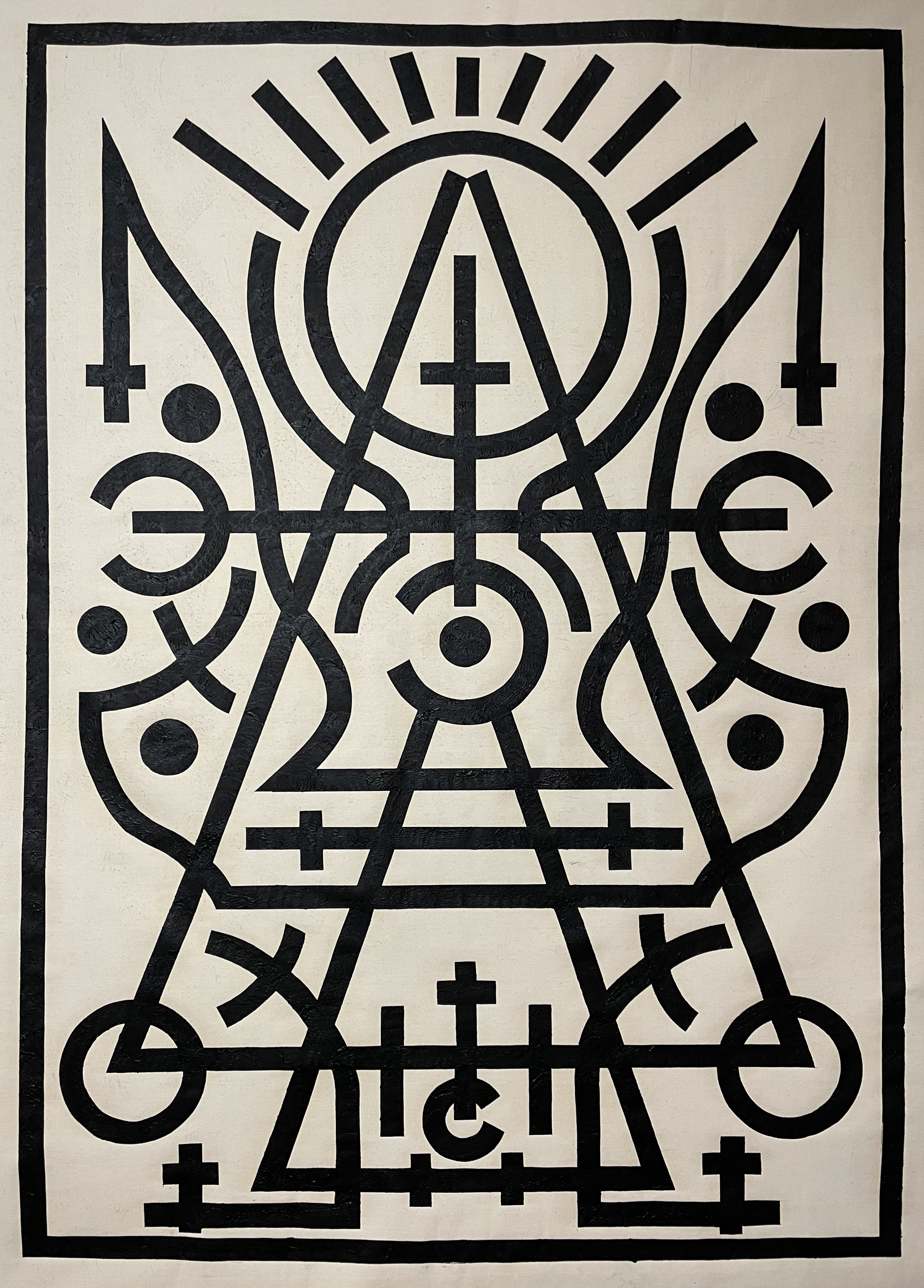
Like a maze or a matrix, Ntokos’s hieroglyphic paintings draw the viewer in, challenging a deciphering, coercing in a visual narrative of sorts, yet nevertheless managing to remain evocatively mysterious. Each element is rendered with precision and chromatic sensitivity, maintaining its autonomy in this way, whilst simultaneously contributing to a broader visual syntax.
Lying on the cusp between the written word and a visual language, these works can be seen both as written manuscripts and abstract paintings. Sometimes the paint makes its presence felt, such as in the work ‘Aken’ of 2024 (to be shown at the upcoming exhibition), in which two strategically-placed red dots, amidst the hieroglyphics, create tension and focal points, adding to the visual experience, and taking us back to the realm of art, as opposed to that of a symbolic language.
Influenced by surrealist principles, Ntokos approaches transformation not only as subject-matter but as a method, allowing forms to shift, overlap, and reconfigure into new narrative possibilities.
With “Mythic Syntax”, Ntokos maps a passage from symbol to system, proposing a living language of signs in constant evolution. The exhibition unfolds as an immersive environment where past and present, image and meaning, remain in flux.
Live Performance – May 17
The exhibition will be activated through a live cello and ink performance by Danae, a cellist and actress whose practice bridges sound, gesture, and visual expression. Through sustained, resonant strokes of the cello, she creates a sonic landscape that echoes the linear intensity of Ntokos’s forms.
As sound unfolds, ink follows, tracing gestures that mirror vibration, rhythm, and breath. The deep tonal lines of the cello become both structure and impulse, extending the exhibition’s exploration of mark-making, transformation, and symbolic language into time and performance.
The symbolism of the scarab
When looking at Ntokos’s overall oeuvre so far, one cannot overlook the important role that the scarab beetle has played in the development of his creative language. In fact Ntokos is well-known for his use of the scarab beetle in his work, a symbol from which his visual language eventually transformed into the hieroglyphic works that followed, the latest forms of which we will see in the exhibition “Mythic Syntax” at Okupa.
Drawing from an early practice in street art and the symbolic lexicon of ancient Egypt, Ntokos had evolved his iconic scarab motif into dense, glyph-like compositions. These ideogrammatic structures resist linear interpretation, instead inviting layered readings shaped by cultural memory and mythological resonance.
Ntokos states the following: “My work is a conversation between signs and change. The scarab is a point of departure, a symbol of rebirth that opens into systems of meaning. I try to let images transform one another until new narratives appear.”
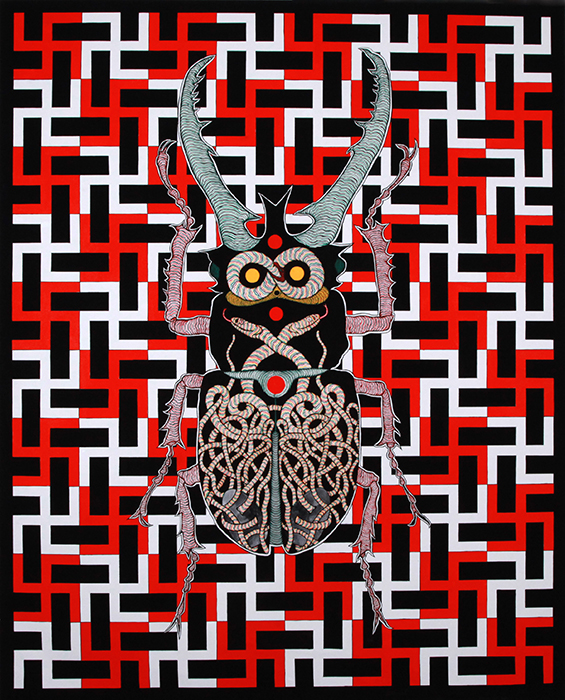
The scarab beetle in ancient Egypt symbolized transformation, renewal, and resurrection, embodying the sun god Khepri’s daily rebirth and the movement of the sun across the sky. As an amulet, it represented protection, good fortune, and immortality, commonly used in daily life and funerary rituals to ensure safe passage to the afterlife. Just as the beetle rolls dung balls, the god Khepri was believed to roll the sun through the underworld and up to the sky each morning, symbolizing the eternal cycle of life. In Dimitris Ntokos’s work, this highly symbolic beetle became the initial inspiration from which his creativity evolved.
The form of the scarab was elaborately explored by Ntokos: it was placed in different abstract contexts, designs and motifs emanating across the picture-plane, connecting with the original scarab motif, at times disguising it, or in dialogue with it. From vortexes to delicate, intricate patterns, that made up the scarab’s new habitat in Ntokos’s paintings, this beetle was taken into the contemporary realm of art by the artist, where its ancient symbolism connected with motifs that resonate simultaneously from today’s world, and those of past cultures.
The power of hieroglyphics
Introduced to the Greek art scene as a street artist, Dokos’s work is deeply influenced by the visual language and symbolic systems of ancient Egypt. Over time, his compositions evolved from the singular presence of the scarab to complex arrangements of hieroglyphic and ideogrammatic forms that dominate the pictorial space.
In his paintings of recent years, Ntokos integrates symbols into a visual language reminiscent of hieroglyphics and calligraphy, shifting attention away from literal representation and toward historical, cultural, and mythological narratives. His meticulous approach to color and technique ensures that each symbol maintains its individuality within the composition, while simultaneously contributing to layered meanings and multiple interpretations. Influenced by surrealism, Ntokos embraces metamorphosis as a core philosophy, using his work to transform familiar imagery and challenge perception.
Brief bio
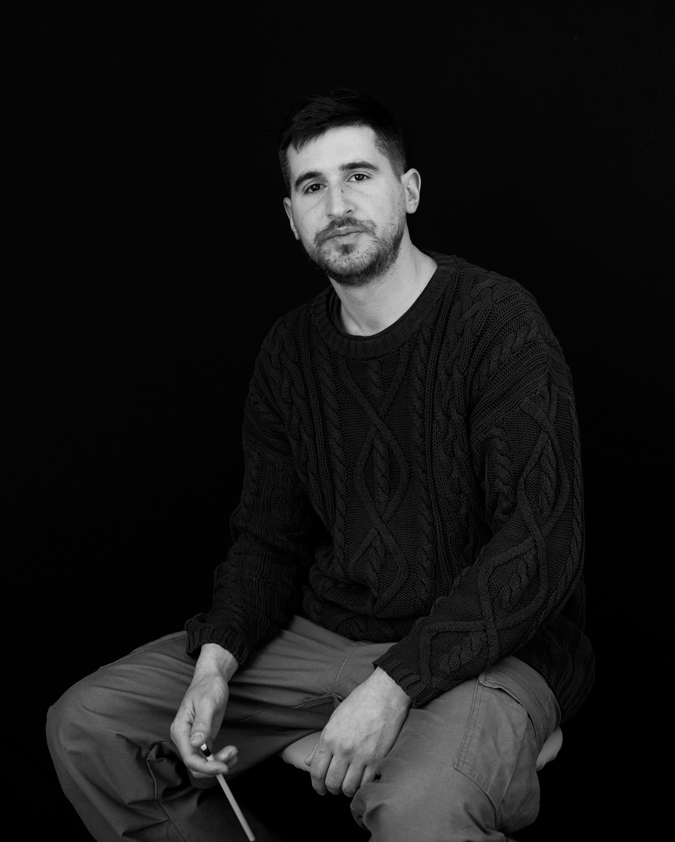
Although self-taught as a fine artist, Ntokos is a graduate of the Department of Graphic Design and Architectural Design, where he worked professionally for six consecutive years. Since 2011, he has participated in numerous solo and group exhibitions, as well as art fairs, both in Greece and internationally. In 2017, he was a speaker at Art History Week at the College of Athens. Born in 1984, he lives and works in Athens. His most recent solo exhibition took place in 2025 in Madrid, Spain, at UVNT Art Fair with Al-Tiba9 Gallery.
About Okupa
A relatively new cornerstone of Athens’ growing creative community, this unconventional urban hub in the heart of the city opens its doors both to local and international artists. It is a multi-functional space, where someone can stay (book a room), try culinary delights (at the restaurant), and see art (in the exhibition space). Okupa aims to contribute a new and dynamic chapter in Athens’ cultural landscape where contemporary experimentation resonates alongside ancient echoes.
Interview
What follows is a short interview with artist Dimitris Ntokos, where he explains more about his work:
The scarab beetle, what does it mean to you?
The scarab beetle, for me, is a symbol of transformation and rebirth. I’m fascinated by the idea of constant movement and creation from something seemingly humble. I see it as a small carrier of energy that holds an entire world within it.
How and/or why did you choose this subject?
The choice emerged gradually. At first, I was drawn to its form, its symmetry, and its power as a symbol. Then I began to explore it more deeply, both visually and conceptually, and it became a core element around which my work developed.
Tell us a bit about your painting technique.
My technique is based on layering and repetition. I work with detail, gradually building the image through small elements. I’m interested in precision, but also in the rhythm created through repeated gesture.
What inspires your patterns?
My patterns come from many sources: nature, traditional ornamentation, ancient art, as well as personal symbolism. It’s a way for me to organize chaos and create a sense of continuity.
How did you develop your hieroglyphics?
The hieroglyphics began as spontaneous symbols, almost like a personal diary. Over time, they evolved into a more structured system, while still maintaining their free and intuitive character.
What languages have influenced your hieroglyphics?
I’ve been influenced by ancient writing systems, such as Egyptian hieroglyphics, as well as contemporary forms of visual communication like symbols and graffiti. I’m more interested in the visual power of writing than in its literal reading.
Street art vs gallery art: pros and cons?
Street art has a direct relationship with the public and the urban space; it’s alive and unpredictable, but also more ephemeral. Gallery art offers focus and permanence, but perhaps less immediacy. For me, both environments have their own value and function complementarily.
- “Mythic Syntax”, a solo exhibition by Dimitris Ntokos opens on Wednesday, April 29, 6-9pm, at Okupa, Psaromiligkou 9, Athens 105 53 – Kerameikos. Runs till May 30. Tel: 211 01 09 999. Email: hello@okupa.com
- Contacts: Chryssanthi Papaharissis: ckpapa@outlook.com
- A Domus Art Gallery project: domusartgalleryathens@gmail.com
- For more, you may also visit Dimitris Ntokos’s website here

