Stella Sevastopoulos cathes up with Chicago-based artist Kyriakos Paraskevopoulos, who is currently exhibiting his work ‘Pendulum’, at the National Hellenic Museum of Chicago.
KYRIAKOS PARASKEVOPOULOS is an artist of many talents, but it is his focus on the exploration of the possibilities of sculpture, which intrigues the most in his multi-dimensional oeuvre. And it is his handling of sand, a medium which has been created naturally through erosion and weathering over thousands and millions of years, which sets him apart. This is an artist who has created installations that use sand in a creative way, both to explore form and conceptual freedom. Because even the acoustic possibilities of sand have been explored, as evident in his latest work, ‘Pendulum’ currently on view at the National Hellenic Museum of Chicago.
By combining sand with industrial iron rods, and other more sculptural forms, in the work ‘Rain and Desert Flower’, Paraskevopoulos created an environment which refered both to nature and to the modern age, bridging the gap between them via his unique creative exploration of their formal associations. In this particular work for example, we could be looking at a city, or a cluster of plants, and that is the beauty, that this work manages to merge such different concepts into one unique compositional whole, creating associations between the two seemingly different possible formal interpretations. This work is an ongoing series, rather than a fixed, singular work. The original version with metal rods was created in 2019, while it evolved into a different version in 2020. The concept of an evolving sculptural environment is also true of ‘Anatopos’, another work which takes on different iterations with every installation, adapting to the particular space and context in which it is presented.
Paraskevopoulos’s sculptural environments hark back to antiquity, as if they are remnants of some past civilization, where sand has taken over some of their forms, or where it has caked into forms, but where it is often also used to continue their formal logic beyond the confines of their own sculptural existence. Repeated patterns are created with the sand on the floor, echoing the sculptural forms within the environment, as if they are the future in the making. Primordial forms such as the circle and the square are explored especially.
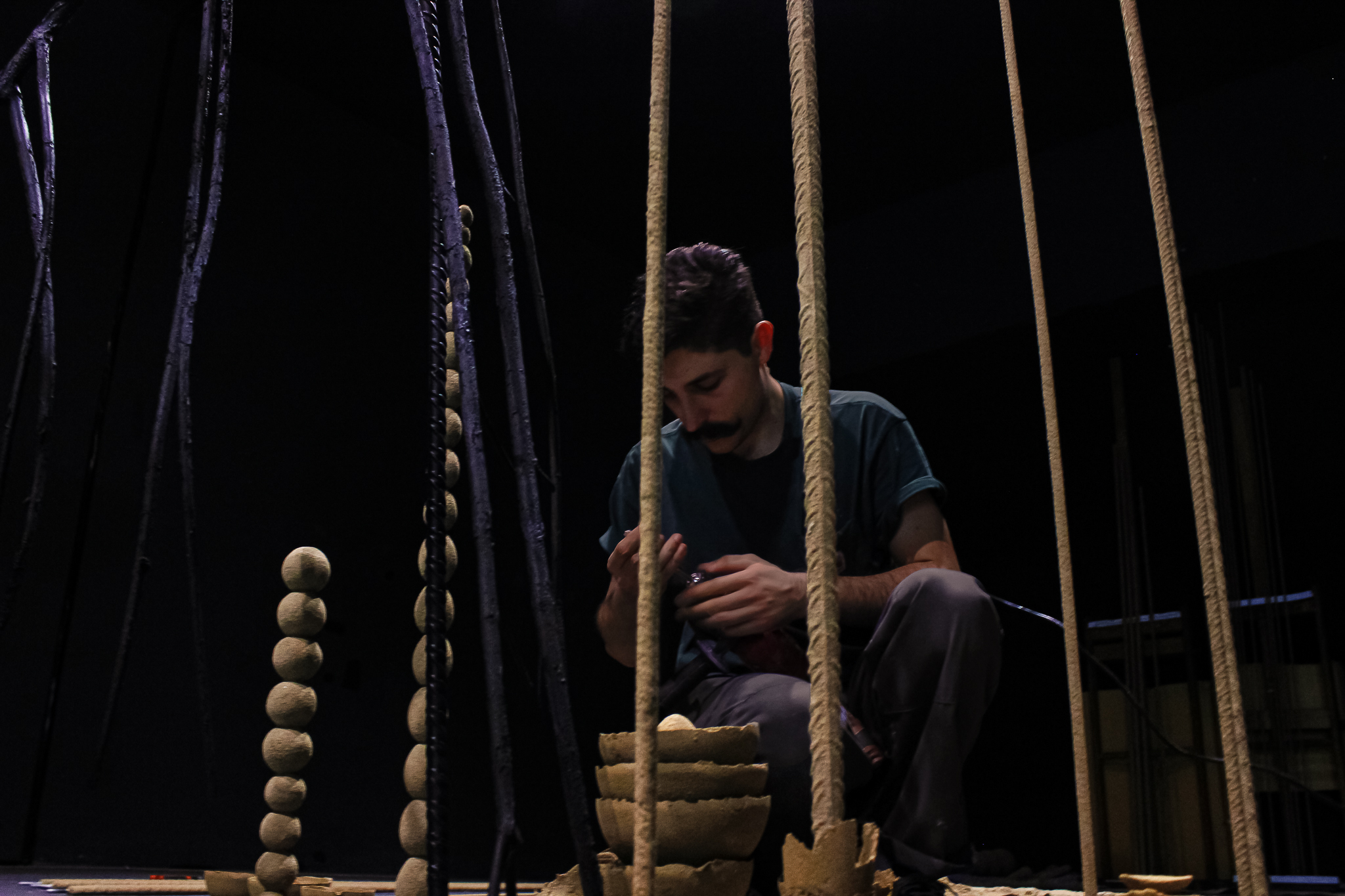
But sand is both ancient and modern: a part of ancient sites, but also a material used in modern urban development. In this sense, a bridge is formed between the ancient and the modern in Paraskevopoulos’s environments. Sand also brings with it associations of ephemerality and brevity: parts of these works can be swept away at a moment. Yet at the same time, it speaks of eternity, due to the age of each grain. With this in mind, Paraskevopoulos’s environments speak of erosion and renewal, of the continuation of time and of the repeated patterns in life forms and civilisations.
Based in Chicago, Paraskevopoulos is active as a sculptor but also as a fabricator, working with metal, mixed-media fabrication, and large-scale construction. His professional experience has allowed him to work in art studios, fabrication shops, theatres and museums. Gaining an MFA in sculpture from SAIC, the School of the Art Institute of Chicago (Fulbright Fellow), after having graduated with honors from the Athens School of Fine Arts (ASFA), he has built and installed complex structures for productions such as Dimitris Papaioannou’s ‘Transverse Orientation’ and contributed to precision-focused fabrication and conservation work at the Kerameikos archaeological site. But alongside his fabrication practice, Paraskevopoulos has also been active as an artist, taking part in international workshops, including at the Delphic archaeological site and the Karlsruhe University of Arts and Design, while his artworks have been included in exhibitions at the Byzantine and Christian Museum of Athens, the Aesthetica Art Prize in New York, and Marina Towers in Chicago (among others).
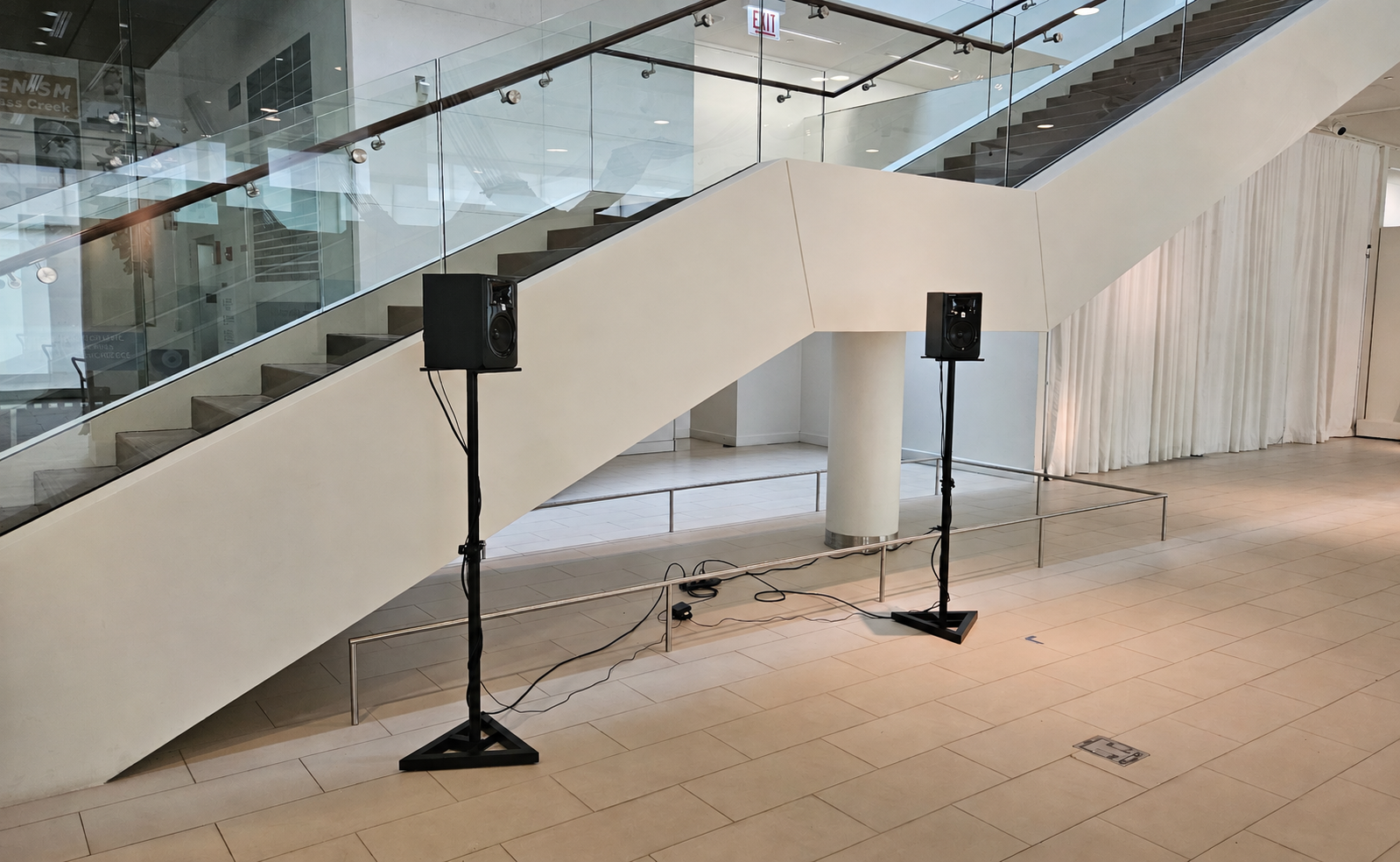
Currently, Paraskevopoulos’s work ‘Pendulum’ is being exhibited at the National Hellenic Museum in Chicago, in the context of the contemporary art exhibition ‘The Odyssey: Reimagined’ – part of a whole host of events exploring Homer’s ‘Odyssey’ at the museum.
What follows is an interview with the artist, where we get a chance to get to know more about his art, and the thought processes behind his evocative sculptural environments.
So, first of all, tell us about the current exhibition you are participating in.
I’m currently taking part in a group exhibition at the National Hellenic Museum in Chicago titled ‘The Odyssey: Reimagined’, which opened on September 25. My contribution to the exhibition is ‘Pendulum’, a stereo sound installation made from contact microphone recordings of sand. I transformed these recordings into sounds that can suggest breathing, waves, friction, and shifting ground. The sound moves continuously between two speakers, creating a recurring back-and-forth motion. In relation to the ‘Odyssey’, I think of this movement as reflecting the rhythm of Odysseus’s journey, with its departures, detours, and delays. Rather than illustrating the story directly, the work approaches homecoming, or nostos, as an ongoing movement toward return, something continually anticipated but never fully resolved.
From ASFA to the Art Institute of Chicago, where you now live and work. Two very different art schools. What struck you as the biggest differences, and what has stayed with you from these two art schools?
The Athens School of Fine Arts certainly left a strong impression on me as a period of great intensity and creativity. From the competitiveness of the entrance examinations and my first encounter with the art world, to the parallel experience of living in Greece during the economic crisis, it was a fertile yet turbulent period of learning.
My experience at SAIC was entirely different, but equally intense. Beyond the considerable difference in facilities and resources, perhaps the greatest difference was that my cohort came quite literally from every part of the world, creating a very interesting and fertile environment. More important to me, however, were the relationships I developed with my professors, whose advice, openness and generosity exceeded my expectations and supported me in ways that extended well beyond the boundaries of academia.
What I carried with me from ASFA is primarily a sense of freedom to experiment with new mediums and different processes. From SAIC, where I arrived at a different stage of my development as a graduate student, I took a greater sense of focus and a deeper engagement with the fundamental concerns of my practice, alongside exposure to new and very different perspectives.
You are an artist who is multi-talented. Apart from the ‘sculptural environments’ which you create, you have also worked in the field of archaeology, in theatre but also comics. Tell us about these different sides to your creativity. Does the one influence the other?
Absolutely. My work has always revolved around drawing and composition, two tools that I believe are inherent to every art form. Through working with different mediums, and through an instinctive curiosity that I believe characterizes every creative person, I gradually came to understand just how interconnected the arts are. It therefore felt very natural for me to enter a new field and try my hand at it, sometimes more successfully and sometimes less so. Inevitably, one experience finds its way into another, sometimes directly and sometimes in ways that only become apparent much later.
You won first prize at the Panhellenic Comic Contest in 2012. Have you continued creating comics?
The truth is, no, and over the years I have often wondered why. I don’t think, however, that there is really an answer, just as there isn’t an exact answer to the question of “why sculpture.” I think of myself more as someone who “makes things I would like to see in the world,” driven by a strong sense of curiosity and by a search for creative processes that allow for sustained concentration. That said, considering the increasingly branching direction my practice has taken since graduate school, which now includes working with 3D animation and sound, I wouldn’t be surprised if comics found their way back into my work in the future, either directly or indirectly.
At the core of your artistic oevre, is your exploration of the art of sculpture, which you have approached in different ways. How would you define the art of sculpture? From your experience of this art form?
I’m not sure I would want to define sculpture in absolute terms. Part of what has kept me engaged with it is precisely how difficult it is to locate its boundaries. Through my own experience, I have come to understand sculpture less as a medium and more as a place from which ideas are discovered and given form. Also, the elusive nature of this place is important to me. I think of it simultaneously as a destination and as a vantage point, somewhere I arrive at and somewhere I look from. This apparent contradiction is fundamental to how I experience sculpture. Its boundaries may remain uncertain, but it is precisely this uncertainty that offers me a particular way of observing, understanding, and ultimately giving form to ideas.
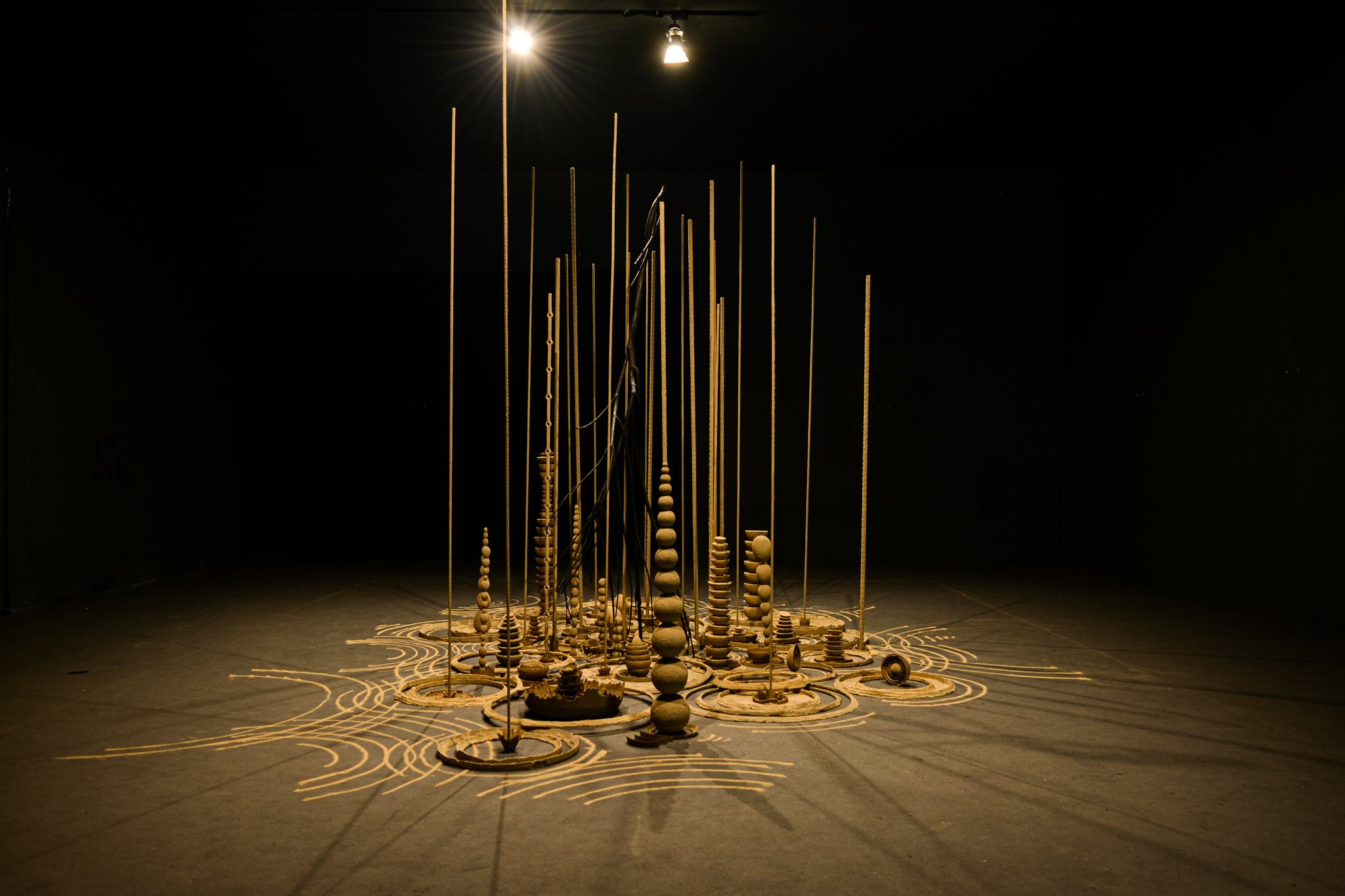
Your sculptural environment ‘Rain and Desert Flower’ incorporates different materials, such as sand (everything is covered in sand) and industrial iron rods, in order to create an environment for growth. The sculptural forms incorporated into this environment can be read as a group of growing plants. Some of their forms for me at least, also remind me of Brancusi’s. Tell us about this work, how it evolved, the choice of materials, and its meaning.
Brancusi’s approach to sculpture has indeed been fundamental to my own, particularly the ‘Infinite Column’. With ‘Rain and Desert Flower’, I was interested in giving form to the act of creation itself while, at the same time, crystallizing a version of sculpture through elements that I recognize as fundamental to the medium.
The work began with a simple drawing, made without any particular intention in mind. Through repetition, its elements gradually multiplied and developed a logic without a clear beginning or end. This process was then translated into space, primarily through considerations of scale.
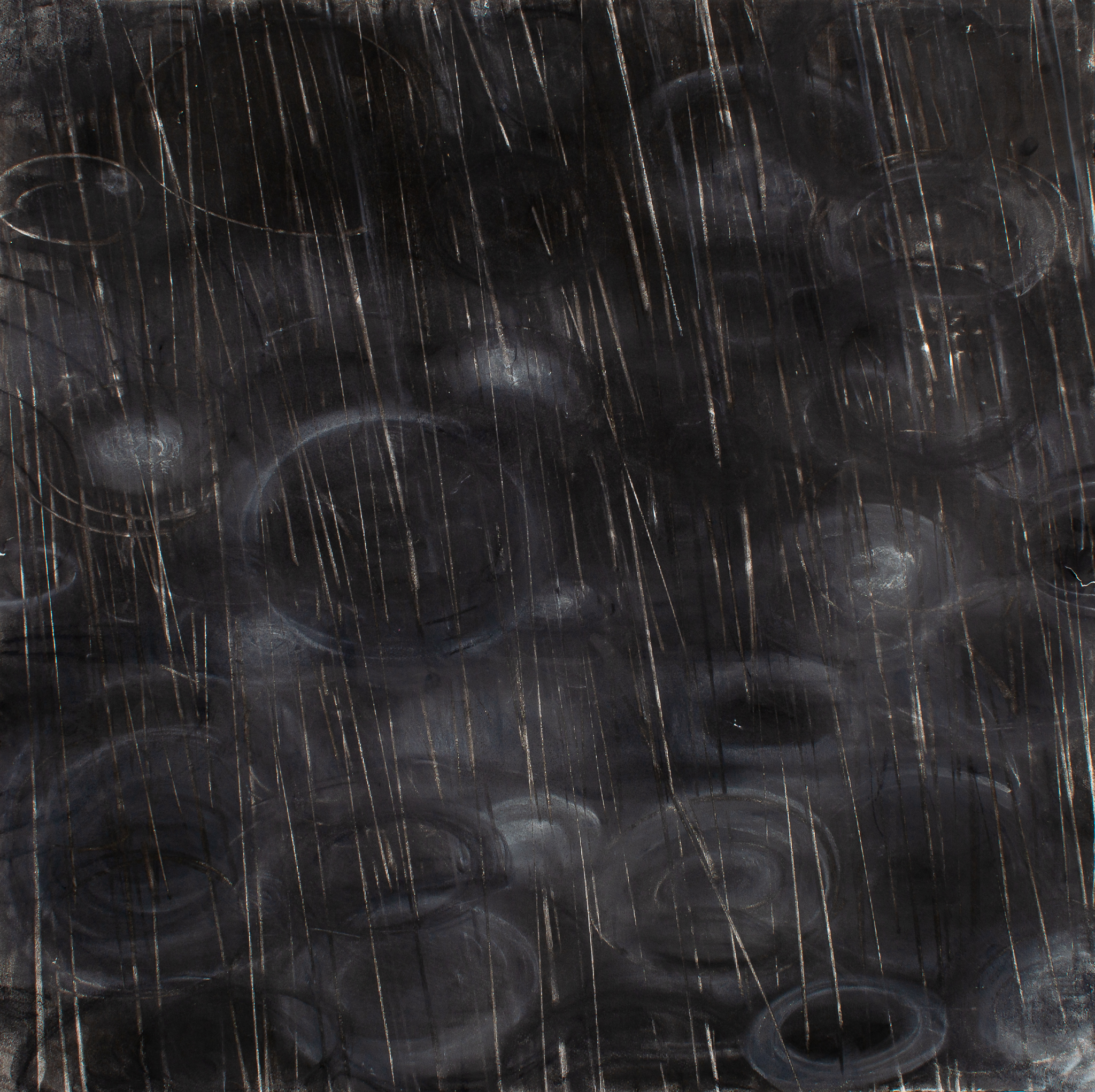
This is also where Brancusi’s influence reappears, not so much as a morphological reference, but through the idea of a sculpture that can imply its continuation beyond its physical limits. I was interested in connecting this sense of expansion to an elemental visual vocabulary – the straight line, the curve, and the circle – and to the visual phenomenon of rain, both as a sequence of individual moments and as a continuous natural phenomenon whose boundaries remain indistinct and constantly shifting.
At the same time, in emphasizing the paradox of conveying fluidity through a static art form such as sculpture, I wanted to push certain properties of the materials themselves to their limits. The plaster forms are multiplied to such an extent that the uniqueness of each one becomes secondary, while the metal rods balance together with the plaster forms through their own weight. As a result, gravity reappears in the work in a different role: from the force that causes rain to fall, it becomes the force that holds the composition intact. The most significant material choice, however, was sand. Through its color and tone, it contrasts with the element of water, while its fluid and shifting materiality simultaneously enters into dialogue with it as another element without clearly defined boundaries.
Finally, the floor itself and, by extension, the empty space around and between the individual elements function as material within the composition. They allow the forms to disperse throughout the space without becoming independent objects, while at the same time determining the distance from which the work is perceived. Hence the term ‘sculptural environment’: the individual elements remain distinct and fragmented, yet together they constitute an indivisible body whose boundaries do not necessarily coincide with the boundaries of the objects themselves.
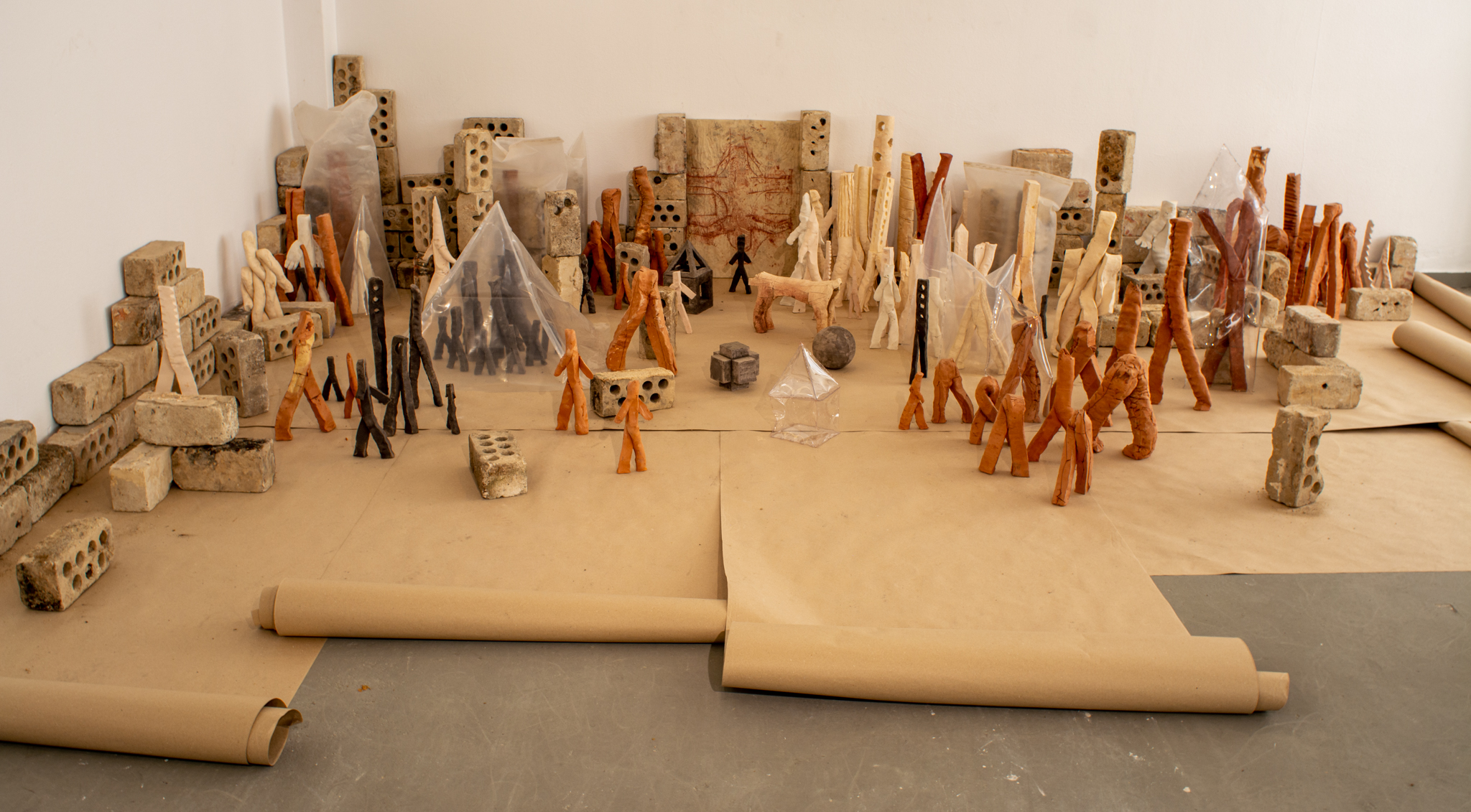
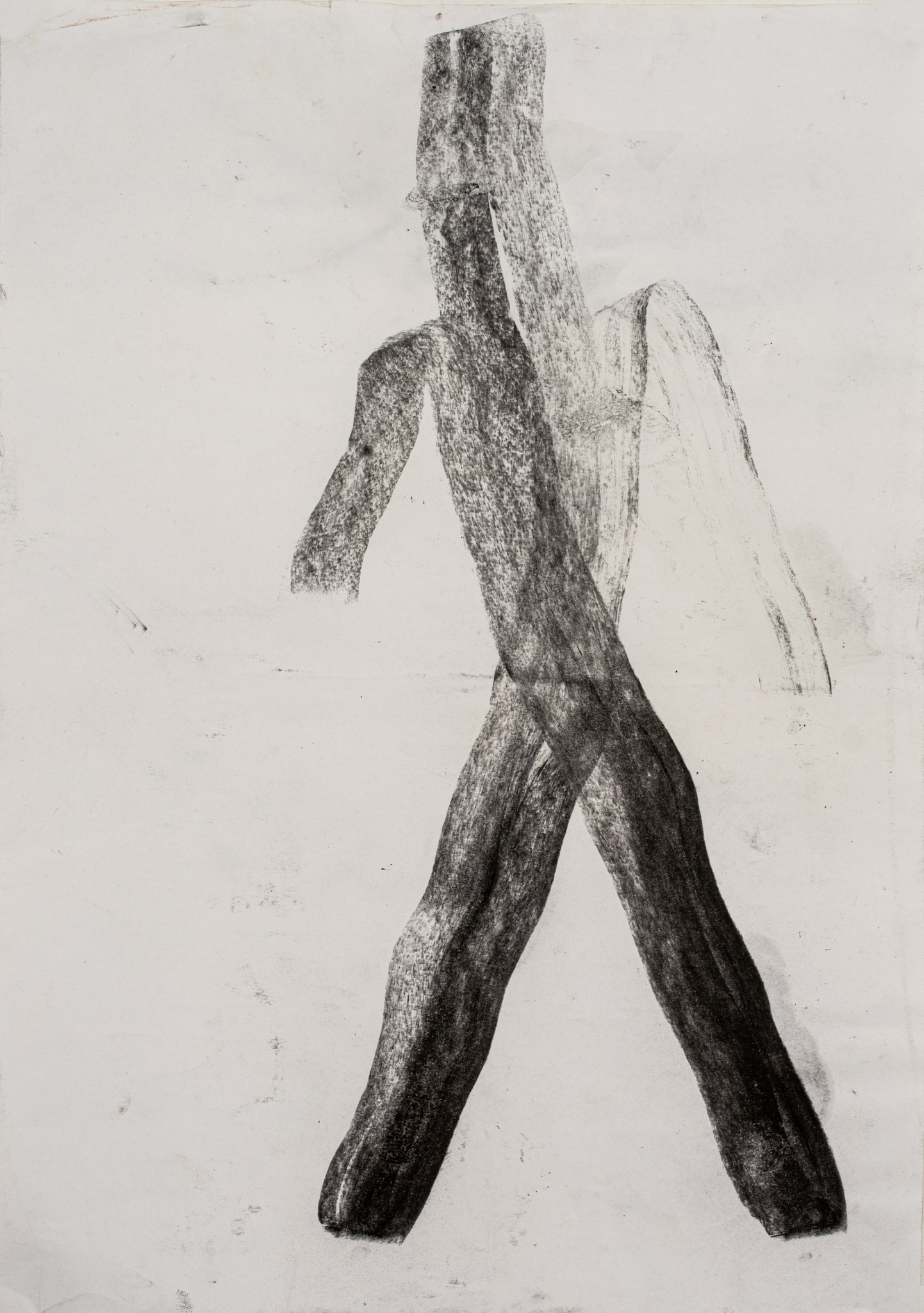
Tell us about the sculptural environment/work ‘Two Legs’, and how it evolved. I find the drawings for this project especially intriguing, the way you have used the charcoal on its side in some of them. Why seperate the legs from the human body and have them walk alone?
I think ‘Two Legs’ is a work that resists an entirely clear-cut explanation. Within the broader context of my practice, I now see it primarily as a transitional work, situated between a period of learning and the gradual development of a more personal language. It began with a professor prompting me to work with the phrase “two legs,” whose ambiguity intrigued me: it referred immediately to the human figure, while at the same time suggesting a much more elemental sculptural condition. Through a playful approach to materials, the two legs began to repeat and shift in scale and form, moving between human, animal-like, and geometric shapes. At the same time, using charcoal on its side was a direct way of transferring the shape of the clay onto paper, allowing me to explore the relationship between drawing and sculpture as a two-way process. Because I was not working toward a predetermined idea of completion, materials such as bricks and PVC, initially used to shape and support the forms, gradually became integral parts of the installation. Looking back at the work today, I recognize in this process an early, more instinctive exploration of the relationship between the individual and the whole, material and form, sculpture and space – concerns that later became much more deliberate within my practice.
You have also focused on the human figure in a more classical way in some sculptures and busts. These contrast with the more minimal, abstract aesthetic of your other works.
These early studies certainly feel quite distant from my current practice. I distinctly remember the pleasure of making them as I was discovering sculpture as a new and unexpected direction. Today, I see them primarily as part of the process through which I came to know the medium itself and became familiar with the materiality, observation, and manual/craft aspects of sculpture. At the same time, they were an early encounter with the role of scale and with the way a form occupies and is perceived within space. In that sense, I consider them more a part of my development as an artist than works I would try to connect directly to the way my practice evolved later on.
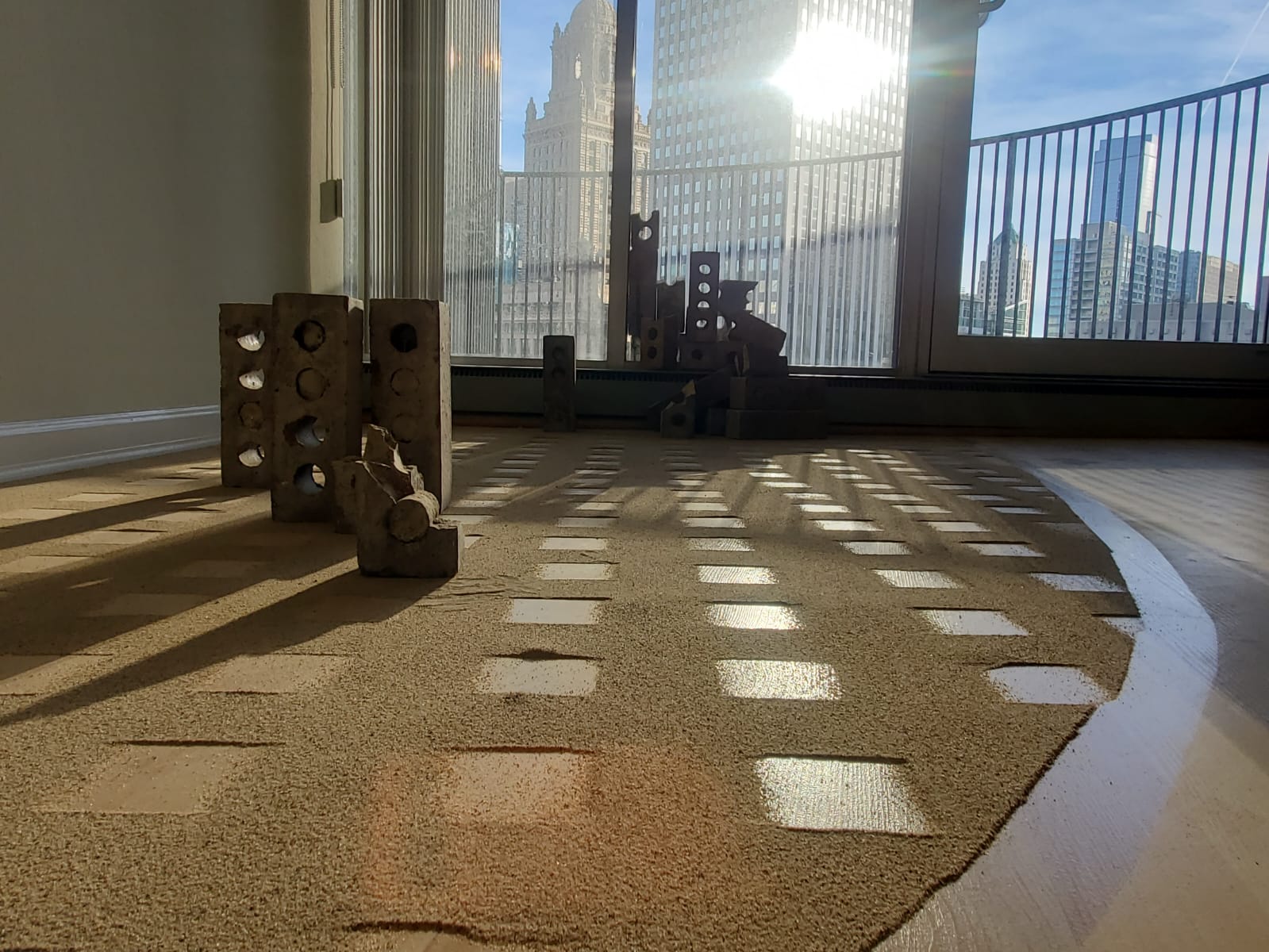
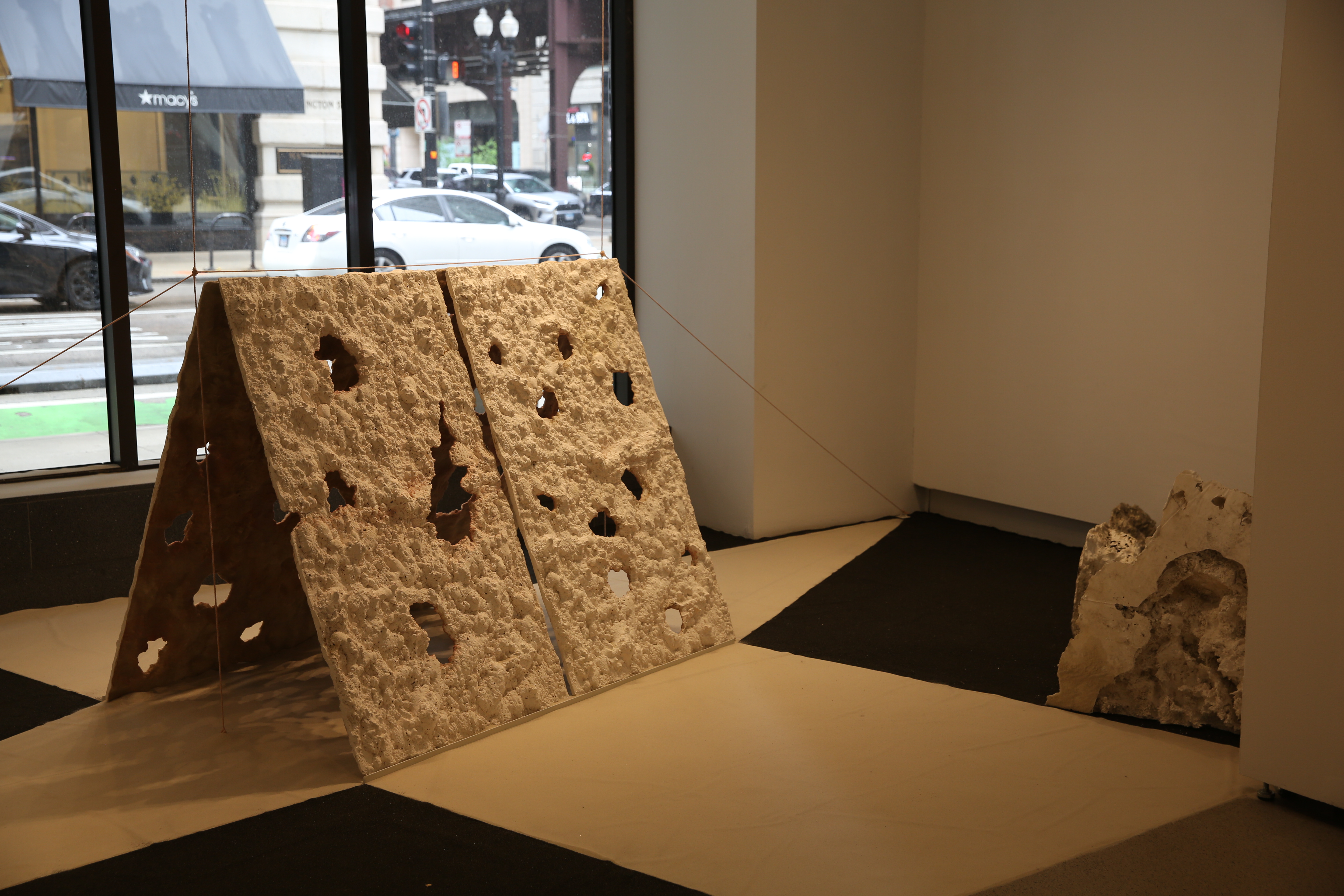
Tell us about the works ‘Anatopos’ and ‘Forced Acts of Affection’, and how they came about.
The two works are closely connected, as ‘Forced Acts of Affection’ emerged from the process of ‘Anatopos’. I began ‘Anatopos’ during a period when I was essentially trying to redefine my practice, as I transitioned from ASFA in Athens to SAIC in Chicago. To this day, it remains an open laboratory for materials and ideas, where forms are constructed, moved, dismantled, and reappear in different configurations. Gradually, this process began to interest me not only as a way of making, but more as a meditation on movement, both material and psychological, and on accepting it as a condition without necessarily having a fixed destination.
Through this process, ‘Forced Acts of Affection’ began to take shape, and for me it has a more personal character. In a way, it explores the idea of belonging between two different but interconnected conditions. On the one hand, there is the seemingly paradoxical condition of moving along boundaries, but also actively seeking them as an artist, while at the same time seeking the attention and gaze of others. On the other, there is a reality marked by intense division and uncertainty, population displacement, and war, which the work absorbs without attempting to represent directly.
This uncertainty takes on a literally material dimension in the work. The structure resembling a shelter remains unsupported, held together only by its own weight. The ropes create the impression of support without actually providing it, while the ground of sand defines a space whose integrity is disrupted the moment someone attempts to cross it. The orientation and positioning of the work also determine its physical boundaries and the viewer’s position in relation to it, which underlines the institutional dimension of the exhibition space.. Ultimately, this material ambiguity opens onto an expanded condition in which the personal and the collective begin to permeate one another.
You have also worked with Dimitris Papaioannou in the production of ‘Transverse Orientation’. What did you create there?
I became involved after a dancer friend told me that Dimitris Papaioannou had put out an open call for Fine Arts students to take part in an internship. Although I had just graduated, I didn’t want to miss the opportunity, so I joined as an assistant in the construction of the sets, working with different materials and props used in the production. At the same time, I tried to spend as much time as possible observing the rehearsals, which for me was just as important as the making itself. Unfortunately, the first COVID-19 lockdown began shortly afterward, and I wasn’t able to remain with the production for as long as I would have liked.
You have exhibited your work in many places, such as at the Christian and Byzantine Museum in Athens, or the Aesthetica Art Prize Exhibition in New York. Are there some exhibitions that stand out the most for you, as an experience?
I particularly remember the exhibitions ‘ASTRAFTERO-BLANK’ at the Numismatic Museum and ‘Tomorrow’s Objects Today’ at Marina City in Chicago, for different reasons. In the first, the invitation to work at a scale related to that of a coin led me to think about its relationship to sculpture and their long history as crafted objects. At Marina Towers, on the other hand, it was Bertrand Goldberg’s architecture itself that directly influenced the way the work developed and was installed. In both cases, what stayed with me was how important it is to remain open to the different ways in which a particular context can influence my work.
For more info on Kyriakos Paraskevopoulos you may visit his site here
Email: kyriakosparaskevopoulos@gmail.com

