AT THE BENAKI PIREOS these days, you will get the chance to see the exhibition Alekos Levidis. Painting 1961–2026. A Lifelong Game, the first retrospective ever dedicated to the work of painter and academician Alekos Levidis. The exhibition encompasses his entire artistic career, from 1961 to the present day, tracing the evolution of his painting over more than six decades of creative work. It is curated by the artist himself, in collaboration with Marika Rombou-Levidi. The exhibition runs till February 14, 2027.
The Benaki Museum has always been, in Levidis’ eyes, the natural venue for an exhibition of this kind. He had been planning and envisioning it for many years. Its realisation marks the culmination of a long-term undertaking, a challenging and demanding project that he experienced as a particular personal challenge.
This initiative, which comprises both the exhibition and the publication of an accompanying book in Greek and English (in two separate volumes), has been made possible thanks in part to the generous support of the Academy of Athens, the J. F. Costopoulos Foundation, the Ministry of Culture, the families of Dimitrios Prokopiou and Michalis and Nikolas Lykardopoulos, Sandra Lykardopoulou, Michalis and Myrto Pateras, and, finally, Nikolas and Eirini Lemos.
Levidis consciously chose to curate the exhibition himself, with the assistance of his partner, social anthropologist Marika Rombou-Levidi. He believes that they know his work better than anyone else, regardless of how specialised a professional may be in the fields of art theory or art history. He sought to bring this familiarity of perspective and intimate knowledge of the content to the exhibition. Their aim is to highlight the connections between the seemingly different categories of the painter’s work, such as drawings, paintings and artist’s sketchbooks.
The exhibition includes more than 500 works, comprising paintings, drawings, murals, theatrical set designs, illustrations for books, installations and artist’s sketchbooks. The exhibition is organised into thematic sections, while the chronological sequence of the works is also taken into consideration wherever necessary. The criteria for selecting the works on display are both “objective” and subjective or emotional. The wall texts, written by the painter himself, are presented in the first person, allowing him to speak directly to visitors and enabling the artist himself to serve as their guide throughout the exhibition. The architectural design of the exhibition space was developed collaboratively by the painter himself, set designer Pavlos Thanopoulos, and the exhibition’s co-curator.
The exhibition
The first section
The visitor’s journey begins with Levidis’s very early works, dating from 1961, when the painter was just 17 years old. The works from the 1960s and 1970s consist almost exclusively of drawings, many of which address political themes. This was a period characterised, both in Greece and internationally, by dictatorships, wars and intense social uprisings. As an adolescent and later as a young man, Levidis followed these developments with interest and concern, recording his thoughts and reflections through his art. Following the restoration of democracy in Greece, these works, which serve as historical documents of their time, were deliberately kept in storage and exhibited only once, in 2006, at Astra Gallery, under the title Testimonies 1965–1976.
The second section
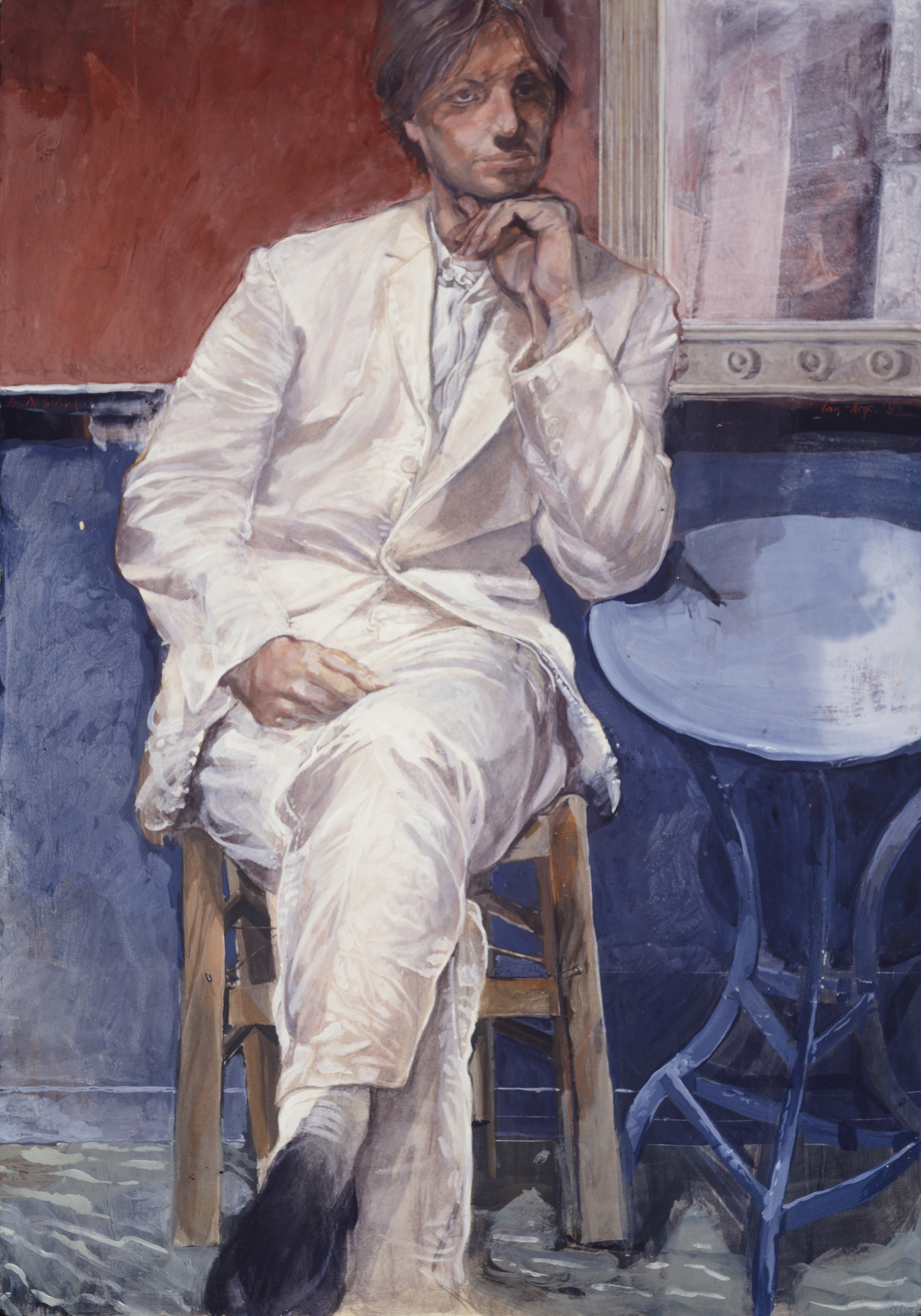
The journey continues with six early portraits, painted at the turn of the 1970s into the 1980s, which introduce visitors to the theme of the human figure. Here, works depicting models, usually in the painter’s studio, executed in mixed media or pastel, alongside drawings in coloured pencil or charcoal, are displayed freely within the space. They are surrounded by figurative works and drawings from other decades, as well as display cases containing artist’s sketchbooks with related material.
A smaller, enclosed space houses thirteen portraits dating from very different periods. Three of these, painted over the past three years, are being exhibited publicly for the first time. They belong to the J. F. Costopoulos Foundation.
The next section
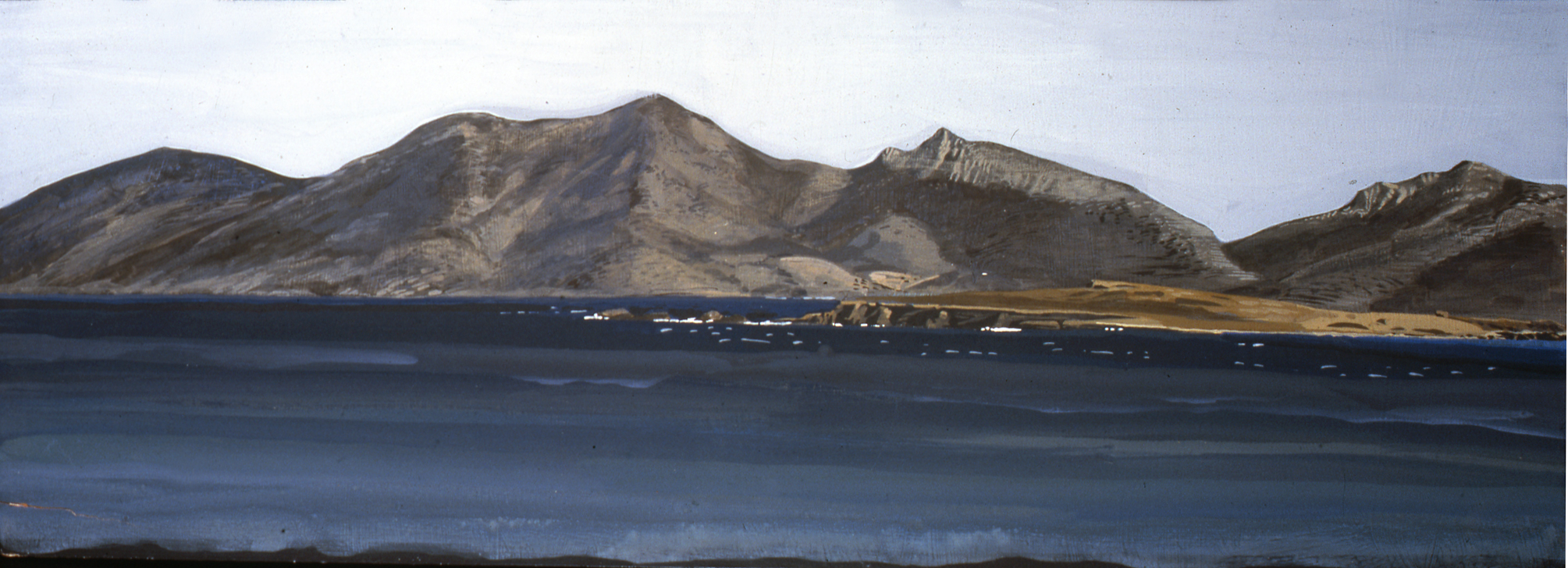
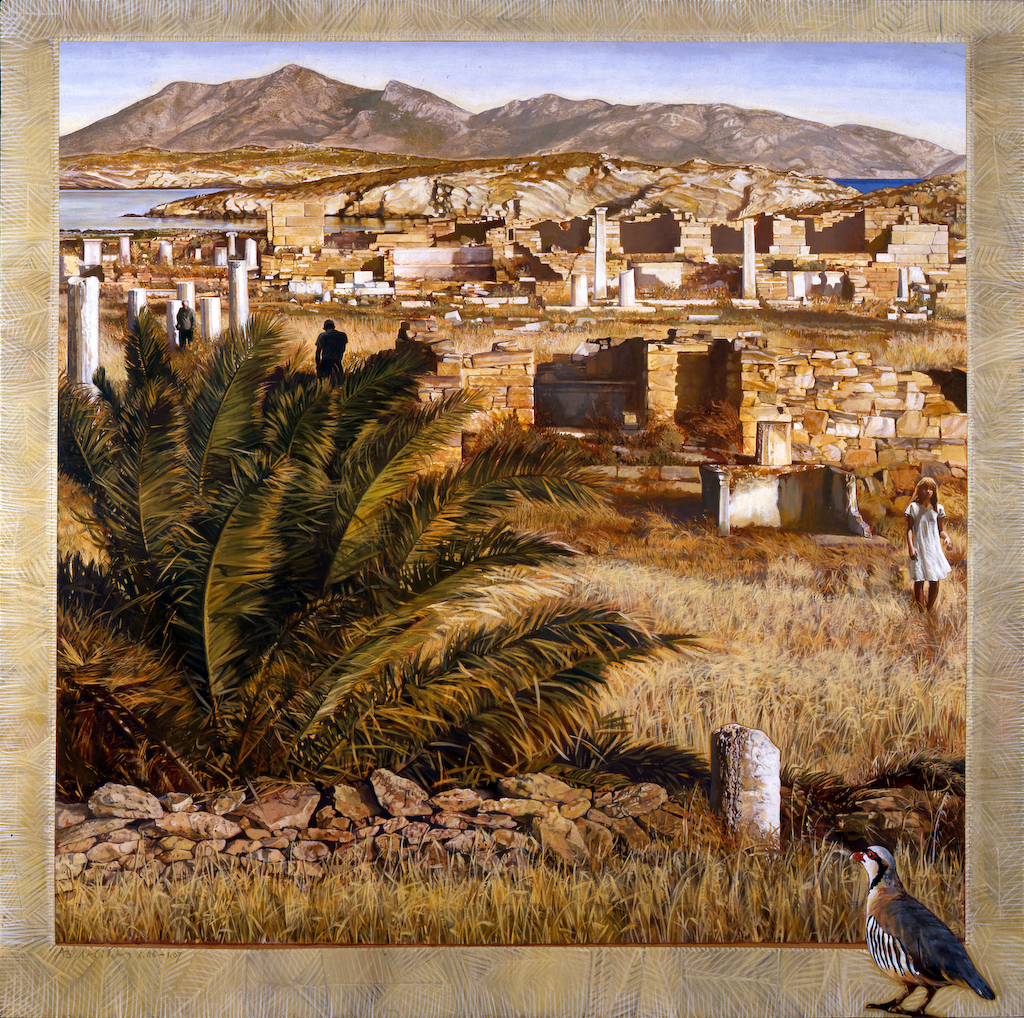
The following section features a series of landscapes interspersed with still lifes, most of which were painted during the 1980s and 1990s. Display cases containing artist’s sketchbooks also trace the painter’s artistic journey during this period. A large, double “gateway”, which forms part of a mural originally created for a private residence, has been reconstructed especially for the exhibition. When the property changed ownership, the mural was carefully detached by the conservation department of the Benaki Museum. Passing through this gateway, visitors enter the section devoted to the works entitled Magna Graecia, which Levidis created in 2000 to mark the beginning of the new millennium, on commission from AGET Heracles.
The Mythistorical works
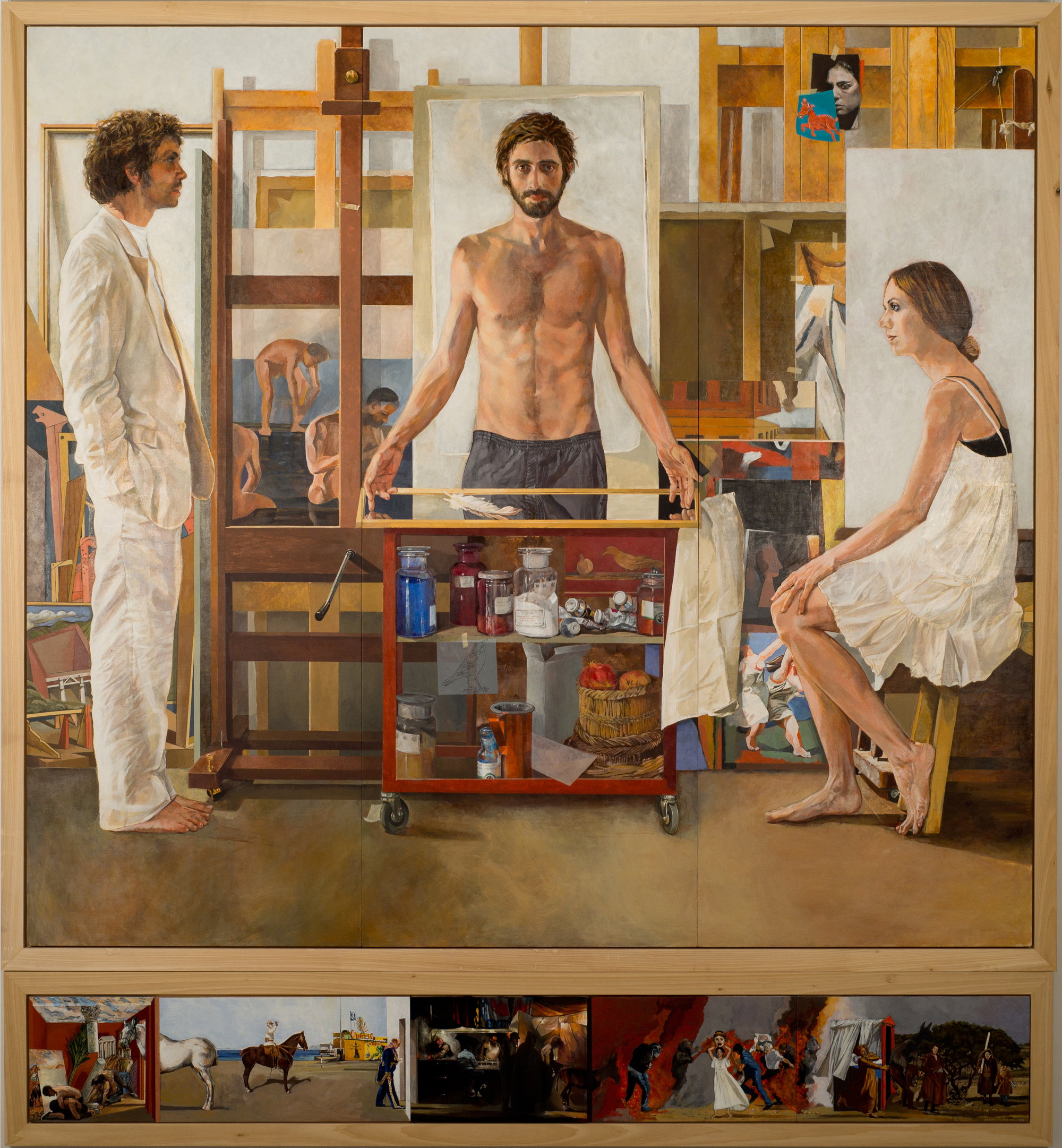
In the very large ground-floor gallery at Pireos Street, specially configured for the occasion, works from the series Mythistorical are displayed. The arrangement of the space consistently seeks to create a sense of depth and openness. These are works in which the artist’s personal history meets the grand narrative of history, and myth encounters reality.
The exhibition includes works from the following exhibitions:
- Bathing Figures (Athens Art Gallery, 1991)
- Twelve Paintings (Athens Art Gallery, 2004)
- Mythistorical (Chatzikyriakos-Ghikas Gallery, 2020)
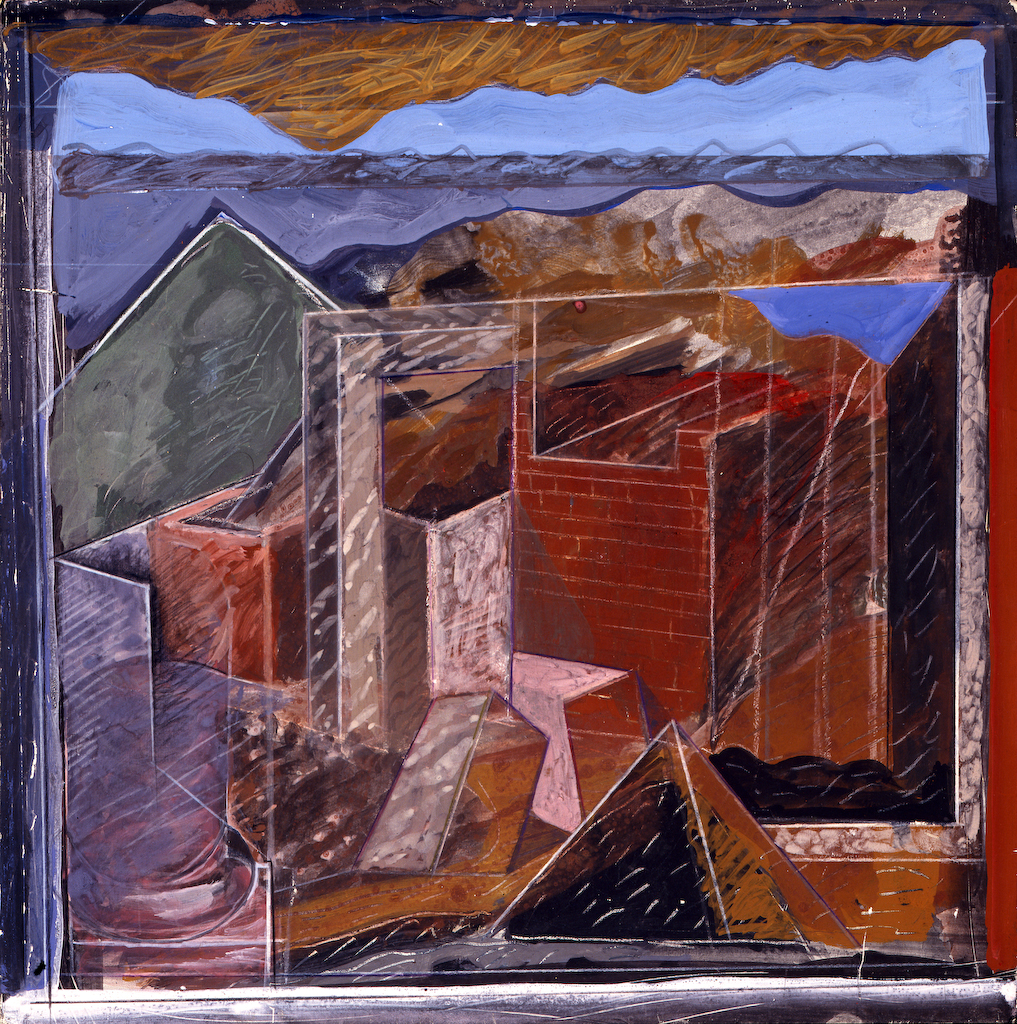
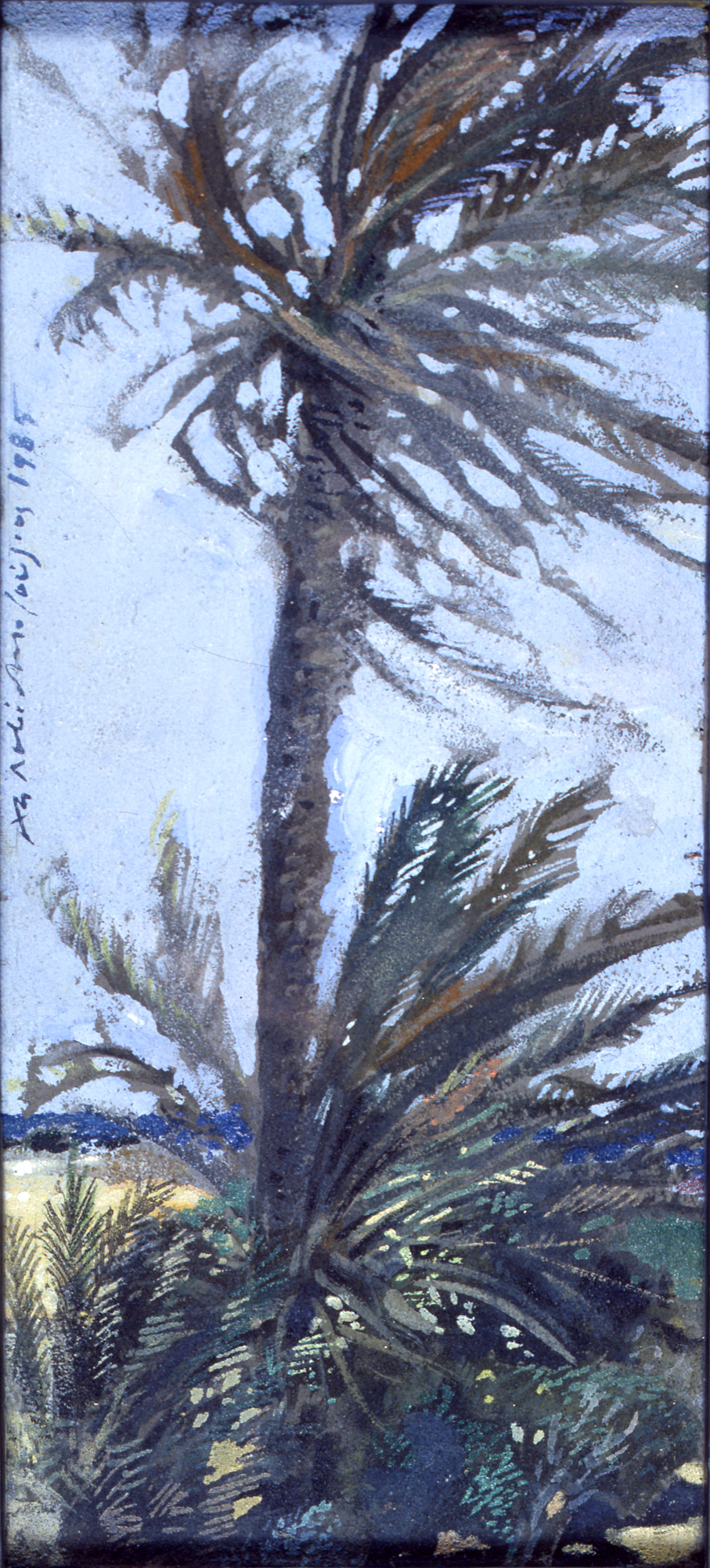
A distinctly defined area within the gallery presents more than thirty small-format, square-shaped works, measuring either 35 × 35 cm (Iconographies, 1990) or 36 × 36 cm (36 × 36: Painting Studies, 2018). These works constitute the seedbed of the “Mythistorical” series and span several decades, from the 1980s through to the most recent years. Display cases containing artist’s sketchbooks complete the presentation of the painter’s artistic journey.
Book cover designs
At the end of the main exhibition space, a representative selection of book-cover designs is displayed, reflecting an activity to which Levidis has devoted himself intensively and consistently throughout his career. His collaborations with Agra Publications, the University of Crete Press, Kedros, Estia, Alexandria Publications, François Maspero Publications, the Athens Concert Hall, the Association “The Friends of Music”, the National Bank of Greece Cultural Foundation and others are brought together here after many years. These works highlight his intention to approach every book cover as an individual painting in its own right.
Installations
The exhibition is complemented by installations, including Memory of Palmyra, which was presented at the museum’s Koumbari Street building in 2016, when Palmyra was looted and the archaeologist Khaled al-Asaad was brutally beheaded by ISIS. Also included are elements of The Armoury (Skevothiki), originally presented at the Argos Festival in 1995 and 2002.
Theatrical set designs
Finally, a separate room on the ground floor of the Pireos 138 building is dedicated to theatrical set designs created by Levidis. The most prominent among these is his set design for Sophocles’ Antigone, directed by Lefteris Voyatzis in 1992 at the Theatro tis Odou Kykladon (Theatre of Kykladon Street).
The publication
The exhibition is accompanied by the publication of a book in both Greek and English, curated by Alekos Levidis and Marika Rombou-Levidi. The publishers are the Academy of Athens and Agra Publications, with Stavros Petsopoulos overseeing the editorial production. The graphic design is by Elli Oikonomidi, in collaboration with the exhibition’s two co-curators. The publication features more than 500 works, texts by Eugenios Matthaiopoulos, Professor of Art History at the University of Crete, and writer Dionysis Kapsalis, critical essays on Levidis’s work, as well as excerpts from the artist’s sketchbooks dating from the 1970s to the present day.
Together, these materials shed light on the development of Levidis’ artistic identity over the years, his everyday painting practice, information about specific works and techniques, and his descriptions, thoughts and impressions of travels, museums and other experiences.
About the artist
Alekos Levidis (Athens, 1944)
In 1963, he graduated from Athens College. During his final two years at school, he systematically attended freehand drawing classes with K. Malamos (drawing from a live model) and A. Kontopoulos (drawing from sculptures at the National Archaeological Museum).
In 1963, he attended a series of seminars in directing and stage design at the Université du Théâtre des Nations in Paris.
Between 1964 and 1969, he studied architecture at the School of Architecture of the University of Geneva (EAUG). In 1965 and 1967, he was awarded, respectively, a special prize and first prize in his school’s freehand drawing competition.
In 1970–1971, he undertook postgraduate studies in Urban Planning at the Institut d’Urbanisme, Université de Paris. Upon completing his studies, he returned to Athens, where he has lived and worked as a painter ever since.
In 1972, he took part in establishing and running the “Strofi” bookshop. At a time of censorship and strict police surveillance, the bookshop developed a multifaceted and pioneering cultural programme.
In September 1974, on his own initiative and using equipment he provided himself, with journalistic coverage by the newspaper Avgi, he organised the first reporting mission by a Greek newspaper to Cyprus following the second Turkish invasion.
In 1982, he held his first solo exhibition at the “Ora” Gallery. Since then, he has held a further 29 solo painting exhibitions in Greece and abroad, and has participated in numerous group exhibitions.
In 1994, he published his book Pliny the Elder, On Ancient Greek Painting, Book XXXV of Natural History (Agra Publications). He co-translated the Latin text with T. Roussos and personally wrote the introduction and commentary. The publication coincided with the excavations of Manolis Andronikos at Vergina, which reignited international scholarly interest in ancient Greek painting. The book filled a significant gap in Greek bibliography concerning the development of monumental painting beyond vase painting, from the Archaic period through Late Antiquity. It consequently became an important reference for younger generations of archaeologists, archaeometrists, conservators and other specialists who were called upon to engage with this emerging field of research. For the past twenty-five years, the book has been taught at university departments and art schools and has been consistently cited in both Greek and international academic literature. In 1995, the book received an award from the Academy of Athens.
In 2007, A. Levidis was appointed Artist in Residence by the Program in Hellenic Studies at Princeton University, where his research focused on On Colours, attributed to Pseudo-Aristotle.
From 2011 to 2014, during the height of Greece’s economic and political crisis, he ran the artistic space “Zografio”, which hosted exhibitions and lecture series devoted to painting.
Beyond his painting practice, he has worked extensively in book-cover design and the artistic direction of book publications.
He has also designed theatrical sets, including those for the historic production of Sophocles’ Antigone at the Theatre of Kykladon Street, directed by Lefteris Voyatzis.
In addition, he has painted murals in private residences in Arta, Syros and Kifissia. Some of these murals have been detached by specialist teams from the Benaki Museum and incorporated into the museum’s collections.
Works by A. Levidis are held in numerous public and private collections in Greece and abroad.
Since 2021, he has been a full member of the Academy of Athens, holding the Chair of Painting.
In 2022, the Presidency of the Hellenic Republic awarded him the honorary distinction of the Gold Cross of the Order of Honour.
For more info, open hours etc, visit the Benaki Museum’s site here
Art Scene Athens is written/run by artist/journalist Stella Sevastopoulos. For more, you can visit the ‘About’ page here

